Tenaga Nasional Berhad (TNB) is Malaysia’s largest electricity company with over 8.4 million customers throughout Peninsular Malaysia and the eastern state of Sabah. TNB’s core activities are in generation, transmission and distribution of electricity ranging from distribution voltages up to transmission voltages of 500 kV. To ensure continuous monitoring of product quality of new and existing assets, the Quality Assurance (QA) Unit within TNB Labs, a subsidiary under TNB Research, conducts a rigorous certification and approval process for both critical and less-critical components and equipment.
This edited past contribution to INMR by F. N. Razman discussed the processes involved in such product certification. Process flow is explained, showing three major activities: technical evaluation; field trial; and verification of quality issues. After certifying a product, a quality audit is conducted yearly at its manufacturer’s location, for surveillance, and subsequently every 3 years for re-certification. Product Inspection and Factory Acceptance Tests are also conducted to ensure every batch delivered is of the quality required by the specifications and standards. Case studies and examples of recent failures and product rejections during field trials and factory inspections are also presented, together with lessons learned in assuring no future recurrence. Finally, a statistical analysis representing product categories with most common failure modes is shown.


Quality Assurance Policy & Procedures
Product Certification Program
All products supplied to the TNB power system must go through several processes to ensure they are fit-for-use, designated Sijil Guna Pakai (SGP). This is specifically applied at TNB Distribution (230 V to 33 kV) for critical as well as less critical level items that can have significant impact on electricity supply and distribution. Engineering Services (ES), formerly known as Asset Management at TNB Distribution (AMD), determines whether a particular product requires certification or not. Every approved item is then given 3 years of SGP validity whereby they are allowed to participate in all TNB tenders for that specific type of product. The flow of the SGP certification program at TNB Distribution is shown in Fig. 1:
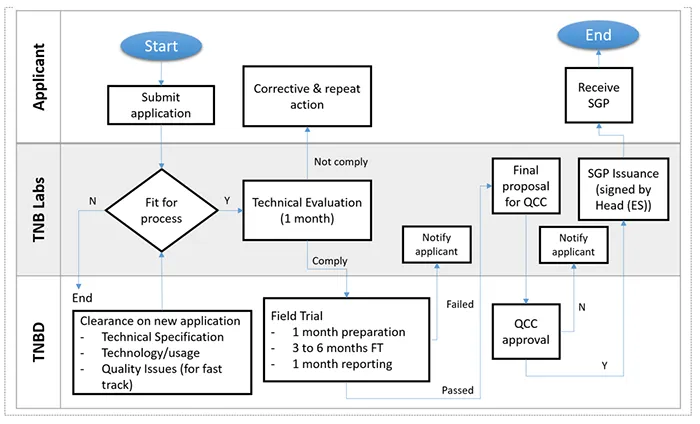
SGP, also known as “Certificate of Product Acceptance”, was introduced to conduct a thorough evaluation of products supplied to TNB to ensure conformance with specifications as well as being fit-for-use in the TNB system. SGP is open for manufacturers (local and overseas) and also local assemblers and applies only for TNB Distribution products. ES at TNB Distribution Network does the initial screening for each SGP application submitted by a manufacturer or supplier based on the product’s use in system. A set of documents is submitted that include the type test report as well as details of the product. Sometimes product samples are also required at time of submission to confirm model and sizes. After a successful screening, TNB Labs will be notified to start the SGP process which includes ISO 9001 verification, detailed technical evaluation based on TNB technical specification and also arrangement of field trial at selected sites for 3 to 6 months. Upon successful of all these process, the product shall be proposed for final approval at the Quality Certification Committee (QCC) which is chaired by Head of Operation in TNB Distribution Network. Successful products shall be granted up to 3 years of SGP validity where they shall be audited every year for surveillance and finally re-certification audits.

Product Categories
In TNB Quality Assurance Policy 2019, it is mentioned under Clause 4.0 regarding product quality control where critical and less critical products were defined. The three main categories we specified as follows:
A. Critical Products
Primary products that energized at rated voltage & Secondary products that ensures safe & stability of TNB operations. Failure of these products may give major impact to electricity supply operation.
B. Less Critical Products
Supporting products that gives mechanical supports or protections. Failure of these products may not give high impact to electricity supply operation.
C. Tools & Measuring Equipment
Tools & equipment used to assist installation, measurement and testing. Tools used to protect safety of staff. Failure of these products may give inaccurate installation or measurement that may give high impact to staff and the products.
Examples of critical products are shown in Fig. 2:
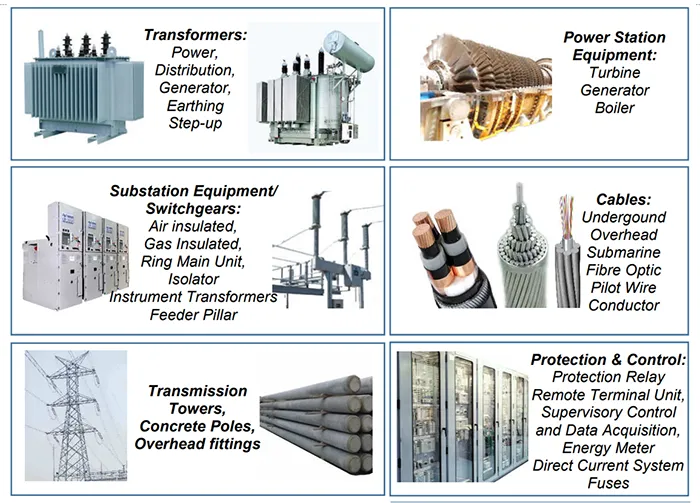

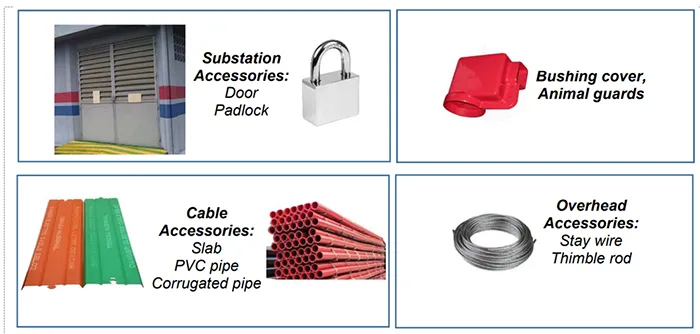
For critical products, SGP are mandatory as per TNB Quality Policy. However, for less critical products, a simpler program called Approved Supplier List (ASL) was adopted. This process only involved specification evaluation and product verification before acceptance. Field trial process (3 to 6 months) at site are not mandatory. Sample of less critical products are shown in Fig. 3, as follows:
Acceptance Criteria
In accordance to TNB Quality Policy 2019, Clause 5.0 explained the acceptance criteria for Type Test location and verification before being accepted for evaluation. The product shall pass the type tests which are conducted at ISO/IEC 17025 accredited laboratories or witnessed by TNB representatives at TNB approved laboratories. Any national accredited laboratories with agreement of International Laboratory Cooperation (ILAC) shall be accepted by TNB. Witnessing engineer shall be also the Subject Matter Expert who is able to comment on the testing procedure and acceptance level as per described in the specification or international standards ie. IEC, ASTM etc.
For quality audits, TNB Labs shall appoint an inspector who is a certified ISO 9001 lead auditor to conduct a thorough inspection before final inspection and audit report is issued. The comments from the audits and inspection shall be discussed in the QCC as an input for recertification. Sometimes, SGP can be revoked if persistent irregularities were reported by the inspector.

Statistical Analysis On Failed Products
Utility industry relies heavily on the use of equipment to facilitate service delivery to customers. Failed products/equipment failure or quality issues are common among manufacturing or utility industry and can be catastrophic, causing widespread outages. These failures have far-reaching effect, resulting in loss of capacity, profit, etc. In TNB, a system called Sistem Maklumbalas Bahan (SMB) is used to monitor the performance of each products installed in the system. The system is monitored by the Procurement and Supply Chain Division which are made available for access to TNB Labs. Fig. 4 shows an example of statistical review of equipment performance from 2017 to 2019.
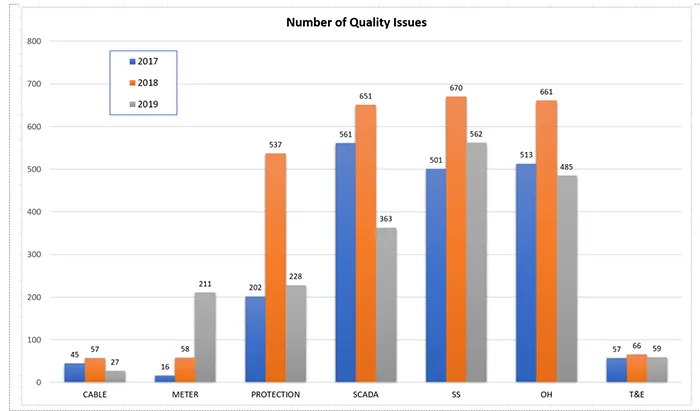
From these statistics, items were categorized by the distribution equipment and sorted by each year starting from 2017 to July 2019. Based on the graph, three main categories reported having the most quality issues are the overhead, substation and SCADA issues. One of the main issues that the system received is the failure of the Charger alarm and High Voltage alarm that frequently occurred for the battery charger product. Besides that, there is also an issue of feeder pillar 1600A on the fuse wiring, neutral busbar and its cover for the incoming feeder. The other issue that brings to the concern is the off-line of RTU and FTU in SCADA system. It had the highest number of quality issues in 2017.

Reported Quality Issues During Field Trial & Product Inspection
There are multiple issues reported by the inspectors and evaluators during Field trial exercise (before SGP) and Product inspection (PI) stage (after SGP). These issues were related to the extreme weather, product quality and also manufacturing practices. Suppliers will be notified and required to submit a root cause analysis with proposal for rectification for each failure found. For PI, a major defect found could lead to the entire batch rejection.
Field Trial
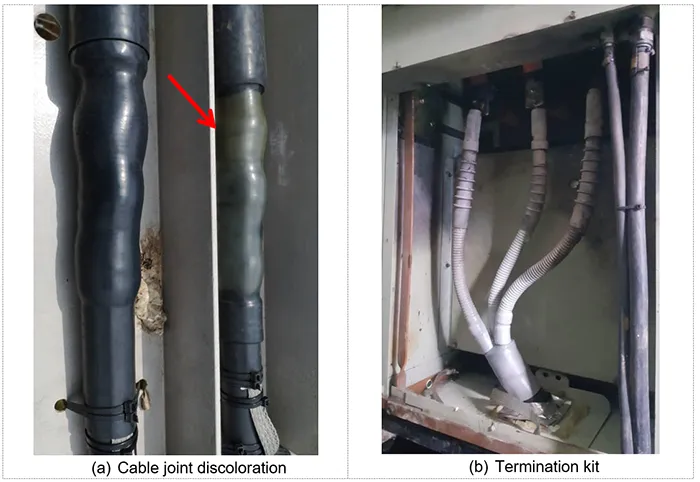
Before SGP can be awarded on certain products, they have to go through a field trial period. The product will be installed at site to be exposed with the real load and weather condition. Most commons issues found are corrosion, water ingress and mechanical failure of the product. An example of the failed product are cable joints where discoloration was found even with low load supply. Further tests were conducted such as IR test and the samples were brought back to the laboratory for further inspection.

Product Inspection & FAT
Some of those reported by the inspectors during PI were the quality of installation. Some manufacturers did not look into details and deliver the finished products without doing the final checking. As a result, when found by our inspectors, it could cause in the entire batch rejection. For product inspection and Factory Acceptance Test (FAT), the sampling and acceptance criteria were as per stipulated in ISO 2859-1 Sampling rate AQL 1.0.
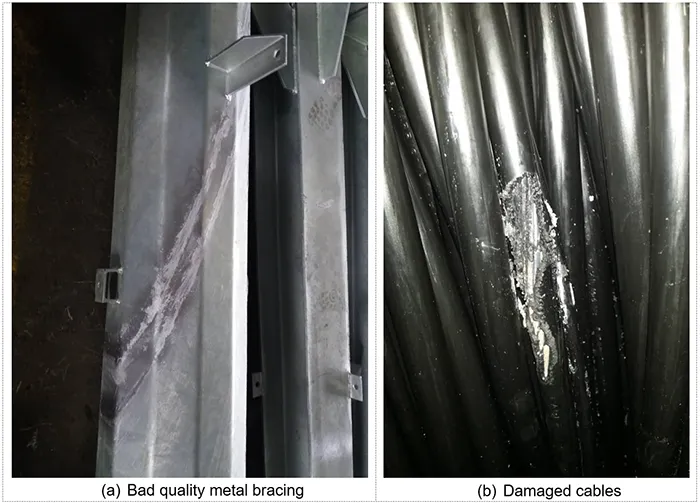
Some of the defective products found during PI and FAT are shown in Fig. 6. The most commonly reported issues are wiring (for SCADA and protection equipment), insufficient galvanising, incorrect labelling system on the product i.e. cables, wrong colour coding, bad welding practices (for metal bracings which supports HV/MV equipment at site), and also wrong material used for insulation.
During PI and FAT, inspectors will be responsible in witnessing and verifying the test conducted and achieved desirable result as pre stated in the specification and standards. Sometimes the range measured were not as per required by the standards, therefore resulting in wrong “passing” of the testing. Therefore it is very important that the inspection to be done by SME who are very well-versed and familiar with the product.
Advantage of QA in Utility Industry
Quality Assurance, in general, is the processes to ensure the production quality meets the requirements of customers. If QA is implemented very well in the utility industries, chances are the costs may be reduced due to the less wastage and re-working of faulty products as the product is checked in every stage. Besides that, it can improve the worker motivation as workers have more ownership and recognition for their work.
In TNB, the SGP program, PI and FAT practices has assisted in reducing huge number of product failures and rejection at site. Faster tendering process has also been one of the main huge advantage where the Certificate of Fitness (SGP) ensures that only product that is fit-for-use to be purchased by the division.
TNB Quality Policy strongly specify the need and importance of quality inspection for each batches of equipment to be used in TNB system and this requirement is mandatory for all division and subsidiaries.
Summary
It is important to look into quality in ensuring high performance products to be used in the system. This is to avoid any catastrophic failure in the system as a whole. For example, wrongly chosen cable and joints might cause a major failure which results in loss of supply and might involve safety of people. Moreover, apart from the additional cost on repair and replacement, the company image and reputation will be damaged.