
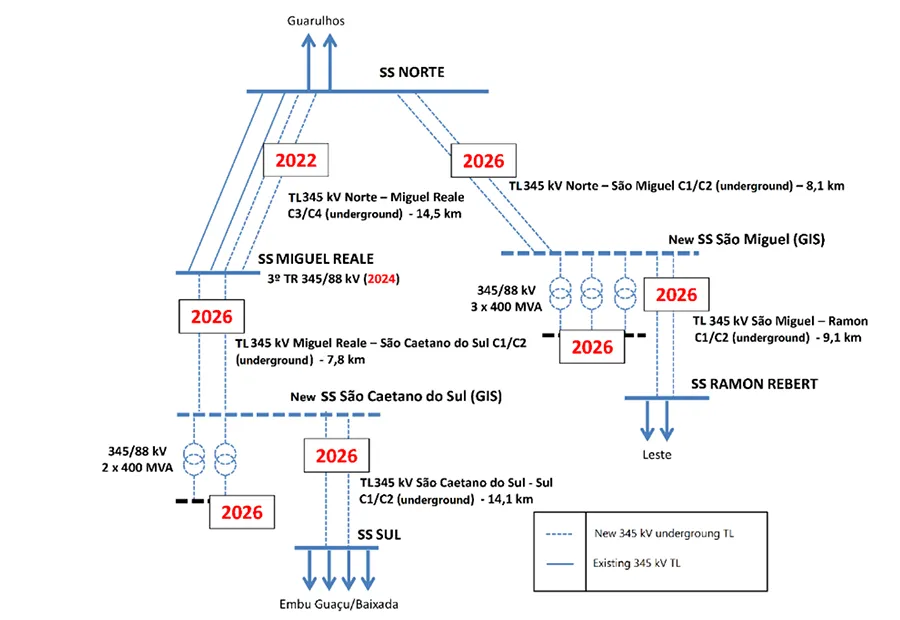
In the years preceding the Brazilian Transmission Auction No. 01/2020, a series of technical studies were conducted under the coordination of the Empresa de Pesquisa Energética (ESP) and the National System Operator (ONS), with the objective of reinforcing the 345 kV transmission network of the São Paulo Metropolitan Region (RMSP – Região Metropolitana de São Paulo). These studies assessed the adequacy of the existing network infrastructure to sustain projected load growth and to comply with enhanced operational reliability criteria, particularly under N-1 and N-2 contingency scenarios (see Fig. 1). As a result, a comprehensive reinforcement plan was developed, involving multiple transmission lots and the strategic implementation of new underground transmission corridors.
São Paulo, the largest city in Brazil and one of the most densely populated metropolitan regions in Latin America, presents extreme challenges for the deployment of high voltage infrastructure due to the saturation of urban space, the complexity of existing underground utilities, and the unavailability of rights-of-way for overhead transmission. With a population exceeding 22 million inhabitants and housing critical industrial, financial, and logistic sectors, any project involving the construction of underground transmission lines in this region requires innovative engineering approaches, meticulous thermal and electromagnetic planning, and strict compliance with international technical standards.
These constraints led to establishment of a mandatory requirement: all new transmission lines in the region must be fully underground, and associated substations must adopt GIS (Gas-Insulated Substation) technology. This directive was formalized in the EPE technical report EPE-DEE-RE-047/2019-rev00 and incorporated into the regulatory framework of the auction.
Within this context, Lot 7 of the Transmission Auction comprised design, construction, and commissioning of two high-capacity underground transmission circuits:
• 345 kV Underground Transmission Line Miguel Reale – São Caetano do Sul (LTS MRE–SCU)
• 345 kV Underground Transmission Line Sul – São Caetano do Sul (LTS SUL–SCU)
These lines are interconnected through the newly built São Caetano GIS Substation (SCU), strategically positioned to optimize power flow distribution across the South, East, and ABC regions of São Paulo, and to reinforce the 345 kV ring topology with increased operational redundancy.
The principal electrical characteristics of both circuits are:
• Rated phase-to-phase voltage: 345 kV
• Maximum continuous operating voltage: 362 kV
• Lightning impulse withstand voltage: 1175 kV
• Switching impulse withstand volta: 950 kV
• Rated short-circuit current: 63 kA
• Short-circuit duration: 0.5 s
Nominal & Emergency Load Conditions
A distinctive aspect of Lot 7, as explicitly required in the auction technical annexes and aligned with the ONS Power Transmission Procedures – Submodule 2.7, lies in the multi-scenario cable ampacity requirement. Instead of considering only the steady-state operating condition at 90°C, the specification mandated three distinct load cases for cable sizing:
For the LTS Miguel Reale – São Caetano do Sul:
• Steady-state ampacity (regime condition): 740 A, with a load factor of 0.85
• 96-hour emergency ampacity (one circuit out, the other fully loaded): 1255 A
• 4-hour emergency ampacity (both circuits energized and overloaded): 1605 A
For the LTS Sul – São Caetano do Sul:
• Steady-state ampacity: 910 A, with a load factor of 0.85
• 96-hour emergency ampacity: 1435 A
• 4-hour emergency ampacity: 2040 A
All cable ratings were required to comply with IEC 60287 for continuous conditions and IEC 60853 for cyclic and emergency conditions, considering site-specific parameters such as soil thermal resistivity (≤ 1.2 °C·m/W), ambient soil temperature profiles, cable configuration (trefoil or flat), and thermal backfill materials. Additionally, the conductor temperature was limited to a maximum of 90 °C under all operating conditions, including emergencies — a constraint that diverges from common practice, where short-duration overloads typically allow conductor temperatures to exceed 105 °C temporarily.
This constraint introduced a layer of technical complexity in the thermal design, as the sizing margin for cable cross-section was significantly impacted. Ensuring that such high emergency currents could be carried without exceeding 90 °C required advanced modeling, sensitivity analyses for cyclic loading, and detailed cable system simulations using validated thermal models.
Moreover, adoption of real-time Distributed Temperature Sensing (DTS) became a mandatory asset in the system, enabling thermal visibility across the full length of the cables and allowing operators to track and control thermal limits dynamically, particularly during contingency events.
The implementation of these technical specifications in a highly constrained urban environment set a new benchmark for high-voltage underground transmission in Brazil and Latin America.
Plan to be at the 2025 INMR WORLD CONGRESS, where Jody Fujihara an expert with ISA Energia Brazil will detail the planning strategies, engineering design methods, construction technologies, regulatory compliance, and monitoring systems employed to successfully deliver this complex project.