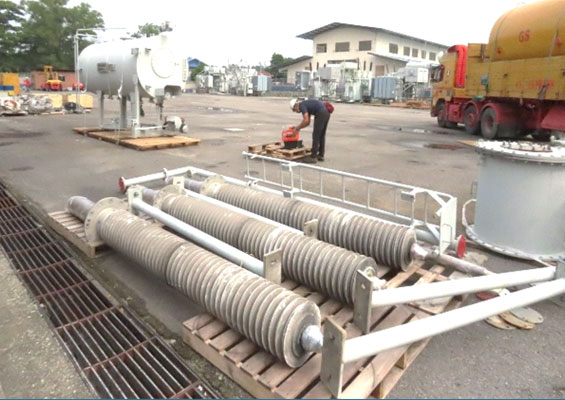

Over the years, different design and manufacturing methods for condenser graded bushings have been available and applied on transmission and distribution grids. While oil-impregnated paper (OIP) bushings are known and used since decades, dry-type epoxy resin-impregnated synthetic (RIS) bushings are fast becoming the selection of choice for system operators and utilities.
Although OIP bushings are a mature technology that fulfils technical standards and requirements in service these types of bushing can be exposed to risks such as potential loss of insulation media or accelerating ageing of the paper insulation due to overheating. Adopting RIS bushings can help minimize such risk while also increasing the safety of transformers and reactors.
Structure & Design of RIS Condenser Bushings
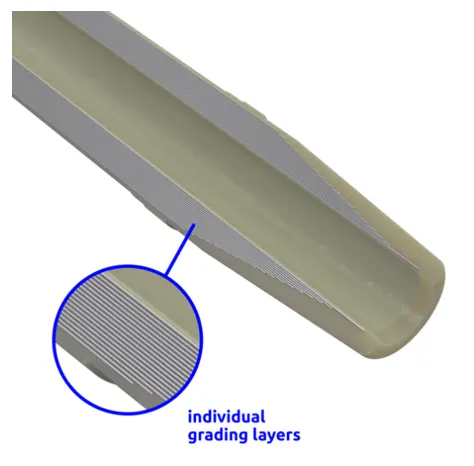
The main component of a high voltage condenser bushing is the so-called active part or condenser core. In the case of RIS, this is a synthetic non-woven as the carrier material for the epoxy resin material in which the aluminum layers for the individual capacitors are concentrically allocated (see Fig. 2). This condenser core ensures the capacitance grading of the bushing.
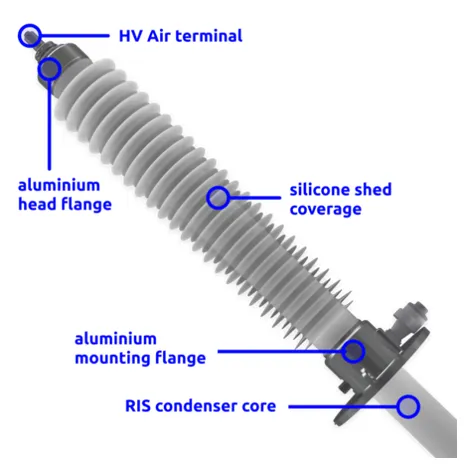
The condenser core is most often housed with a composite insulator covered by silicone rubber sheds, as shown in Fig. 1. The gap between composite insulator and condenser core is filled with a dry-type N2-based foam. Therefore, the bushing is completely dry and free of hazardous fluids and gases such as mineral oil, SF6, CO2, etc. RIS condenser bushings are environmentally friendly in comparison to conventional OIP bushings and even better in regard of LCA compared with RIP bushings.
Plan to attend the upcoming 2025 INMR WORLD CONGRESS in Panama. Alexander Doutrelepont, an expert with Trench & HSP Group in Germany will review the technological and physical advantages of RIS bushings and explain why, due to safety and environmental impact, they are increasingly the selection of choice. He will also outline specific technical and commercial advantages of dry-type condenser bushings housed with silicone rubber sheds.