
ISA Intercolombia monitors lightning activity on its overhead transmission lines using data from the Colombian Total Lightning Detection System (CTLDS), which is based on LINET (LIghtning NETwork) technology. This data enables advanced analytics to assess lightning impact and develop strategies to reduce its severity across the company’s nearly 12,000 km of transmission infrastructure.
An expert system was developed, integrating modules for information, gathering real-time monitoring and prediction. The monitoring and information modules generate near-term failure predictions using lightning characteristics such as density, current, polarity, and multiplicity.
This lightning monitoring and prediction tool enhances the supervision and control of ISA Intercolombia’s transmission assets. It boosts situational awareness at the Control Center, helping engineers respond more effectively to lightning-caused outages. Faster response times can reduce service interruptions, improve system reliability, and lower annual asset unavailability—ultimately benefiting the company’s operational performance and profitability. When a risk alert is issued, the Control Center can proactively assess system conditions, implement mitigation strategies, and coordinate restoration efforts.
The tool also aids decision-making by providing real-time diagnostics of failure causes and weather conditions during outages. This allows for immediate action to restore service or conduct deeper analysis using oscillograph data, especially for failures not caused by lightning. Since lightning is a leading cause of transmission line outages, the system indirectly helps monitor other risks like wildfires or vegetation interference. Moreover, the system supports right-of-way maintenance by warning personnel about lightning threats, helping them decide whether to proceed with or postpone work. The insights generated also support engineering and project teams in designing new transmission lines.
Colombia’s Transmission System
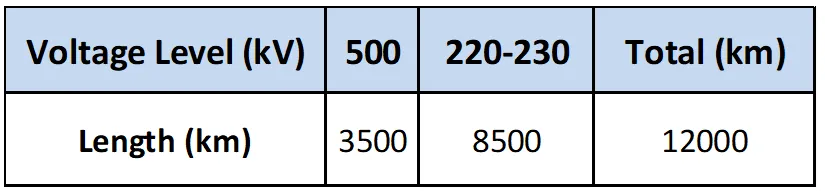
Colombia’s power transmission system is composed of various power utilities, including ISA Intercolombia, which operates approximately 12,000 km of transmission lines nationwide. These lines are segmented by different voltage levels, as shown in Table 1.
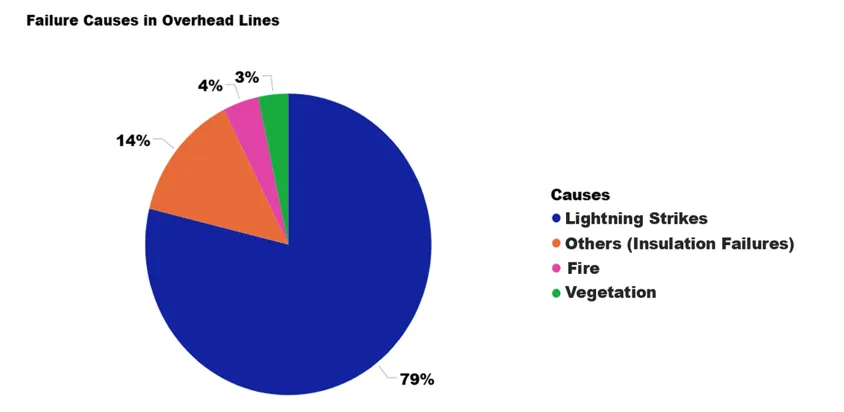
According to the previous figure, failures caused by lightning account for 79% of all transmission line failures and with respect to lightning activity, the table 2 shows the number of lightning strokes detected in the total Colombian territory (1,142,000 km2) varying from 23.9 million in 2021 to 46.7 million in 2023.
Lightning incidence presented an increase during the four-year period with a high value reported in 2023 mostly influenced by the La Niña Phenomenon that marked the prevailing raining conditions in that period. As a reference parameter, maximum peak currents are also given in Table 2. In particular, the number of strokes within a 10 km buffer around ISA´s power lines vary from 2.99 million in 2021 to 8.5 million in 2023.
As described, the power line influence area’s strokes vary from 12.5 to 18.2% of total lightning activity detected in the entire territory during the last four years. Regarding magnitude of lightning currents within the 10 km buffer around transmission lines (see Table 2), maximum discharge current has been increasing over the past four years, reaching a peak of 369 kA in 2024. This suggests not only a rise in the number of lightning strokes, but also an apparent increase in their maximum current, meaning that each year this phenomenon could pose a greater threat to transmission systems.
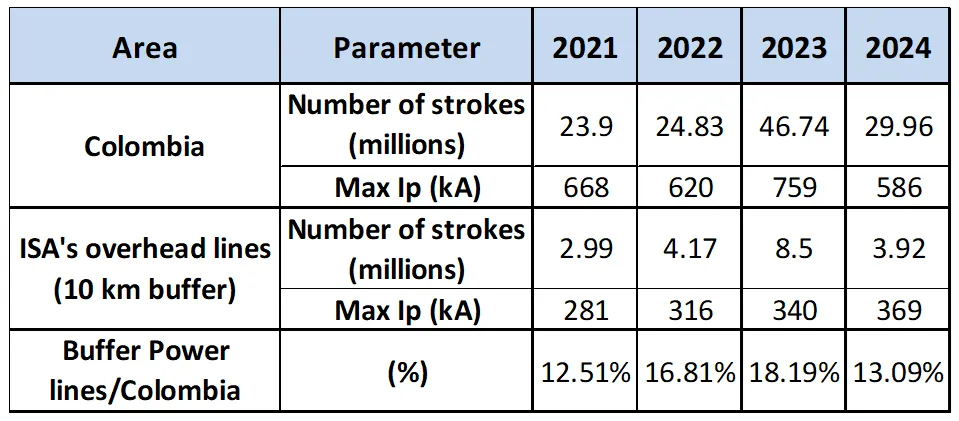
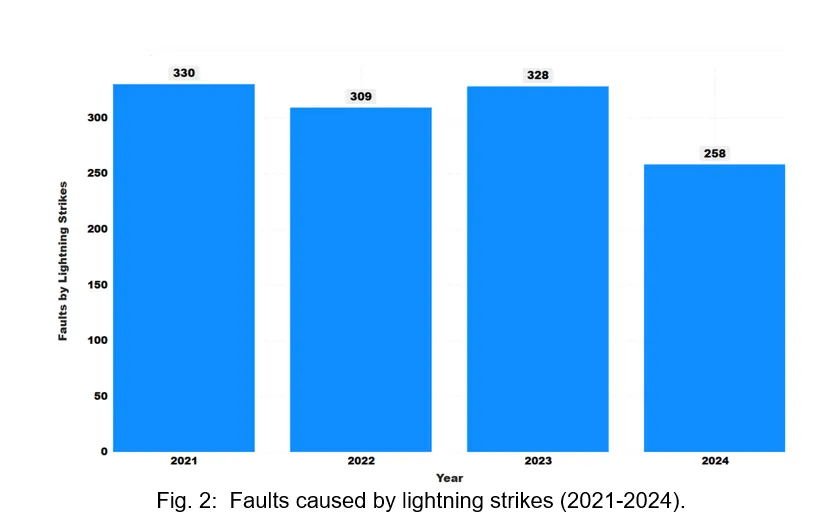
Fig. 2 provides number of failures caused by lightning over the same four-year period (2021–2024). Despite variations observed in number of lightning strokes over the years, lightning-related faults tend to remain stable each year except in 2024, which showed a decrease. This reduction may be due to improved classification of fault causes in transmission lines, resulting from better data interpretation enabled by analytics and enhanced accuracy of the lightning information system.
Plan to attend the upcoming 2025 INMR WORLD CONGRESS in Panama. Ronald Dickson, an expert with ISA Intercolombia will analyze lightning behavior on this TSO’s overhead lines by applying data analytics. He will also review the different lightning monitoring modules that support transmission line operation and maintenance in terms of real-time operation, patrols, failure-cause identification and improving line design.