The edited past contribution to INMR by Krzysztof Lenarczyk of the Technical Standards Department at Polish Transmission System Operator (PSE) and Marek Loboda of the Faculty of Electrical Engineering at Warsaw University of Technology addressed statistical analysis of faults due to shut-downs occurring on high voltage transmission lines with focus on lightning cloud-to ground (GC) discharges recorded in Poland. These are described and discussed in relation to shutdown of 220 kV and 400 kV overhead lines over the period 2006 to 2021.


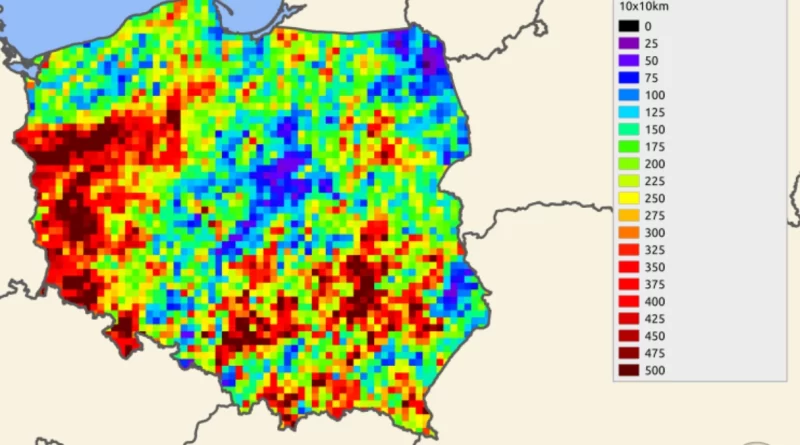
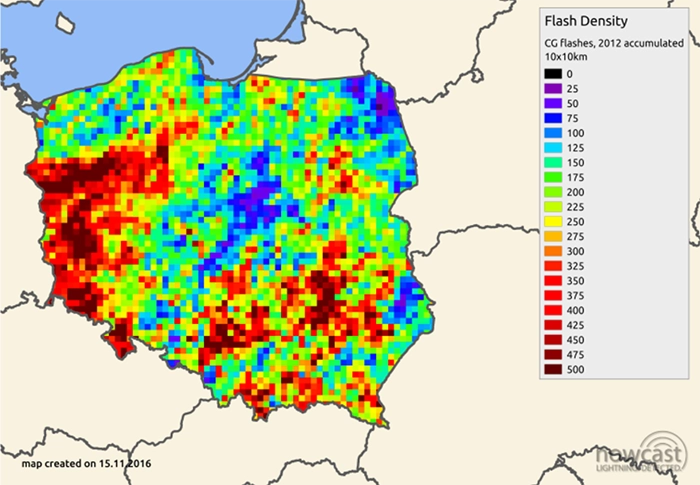
Poland is in a geographical region of Europe where the lighting activity is intense during so called ‘lighting season’, which starts in April and lasts usually up to end of October. Exemplary lightning stroke density map of Poland created by Lightning Location System LINET is shown in Fig.1. According to statistical lightning data available from lightning location and detection system LINET, yearly lightning intensity varies from 0.5 ÷ 8 strokes/km2 depending on region of Poland. The Cloud to Ground (CG) lightning discharges more often occur in southern and central part of Poland.
Lightning discharges can cause significant damage on HV transmission lines resulting in temporary disconnections, shutdowns or reclosures due to the direct strikes but also in temporary disturbances due to nearby strikes. The assessment and discrimination if the shutdown or temporary disconnection of HV overhead line was caused by direct or nearby strike it is in some cases very difficult as the verification of the line equipment damage (i.e. damage to insulator or lightning protection wire) may be done by visual inspection only.
In years 2006-2021 the operator of Polish electric power high voltage transmission system – the PSE company – recorded almost 550 shutdowns of 220 kV and 400 kV lines caused by lightning. The total length of HV transmission lines in Poland was 10,500 km in 2006 and 11,500 km in 2021.
Lightning flash density maps are available for individual years or for certain multi-year period of observation with different resolution per square surface unit i.e. from LLS operator which collects lightning data over Poland.
Exemplary lightning flash density map over Poland in 2012 recorded by LINET is shown in Fig. 1.
The annual number of lightning strikes NL into overhead transmission line can be estimated using the formula:

where: NG is the lightning ground flash density (1/km2×year); AL is the collection area of flashes striking the line (m2). NG may be available from LLS operator data bank directly or may be calculated using simple formula:

where: TD- is number of the thunderstorm days per year and a, b are coefficients which can be estimated for Poland: a =0.036 and b = 1.
For the isolated overhead transmission line on flat ground, the collection area AL is defined by the intersection between the ground surface and a straight line with 1/3 slope, which passes from the ground conductors of the line (touching it there) and length of the line. Determination of the value of AL may be performed graphically or mathematically depending on the tower configuration and number of ground wires.
Assuming that typical equivalent projection of the line tower and conductors in Poland creates rectangle versus ground surface (see Fig.3), the collection area of transmission line AL can be calculated as follow:
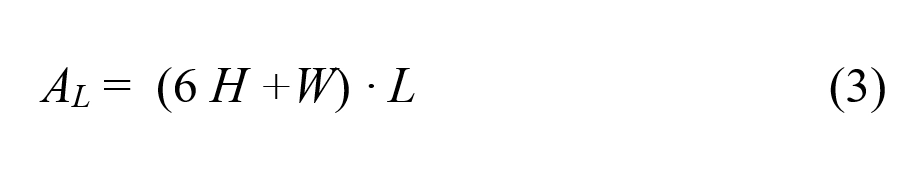
where H – is height of ground wire on the line tower, W – width of the tower and L – length of the line, expressed in meters.

Characteristics Of HV Transmission Lines In Poland & Estimated Lightning Exposure
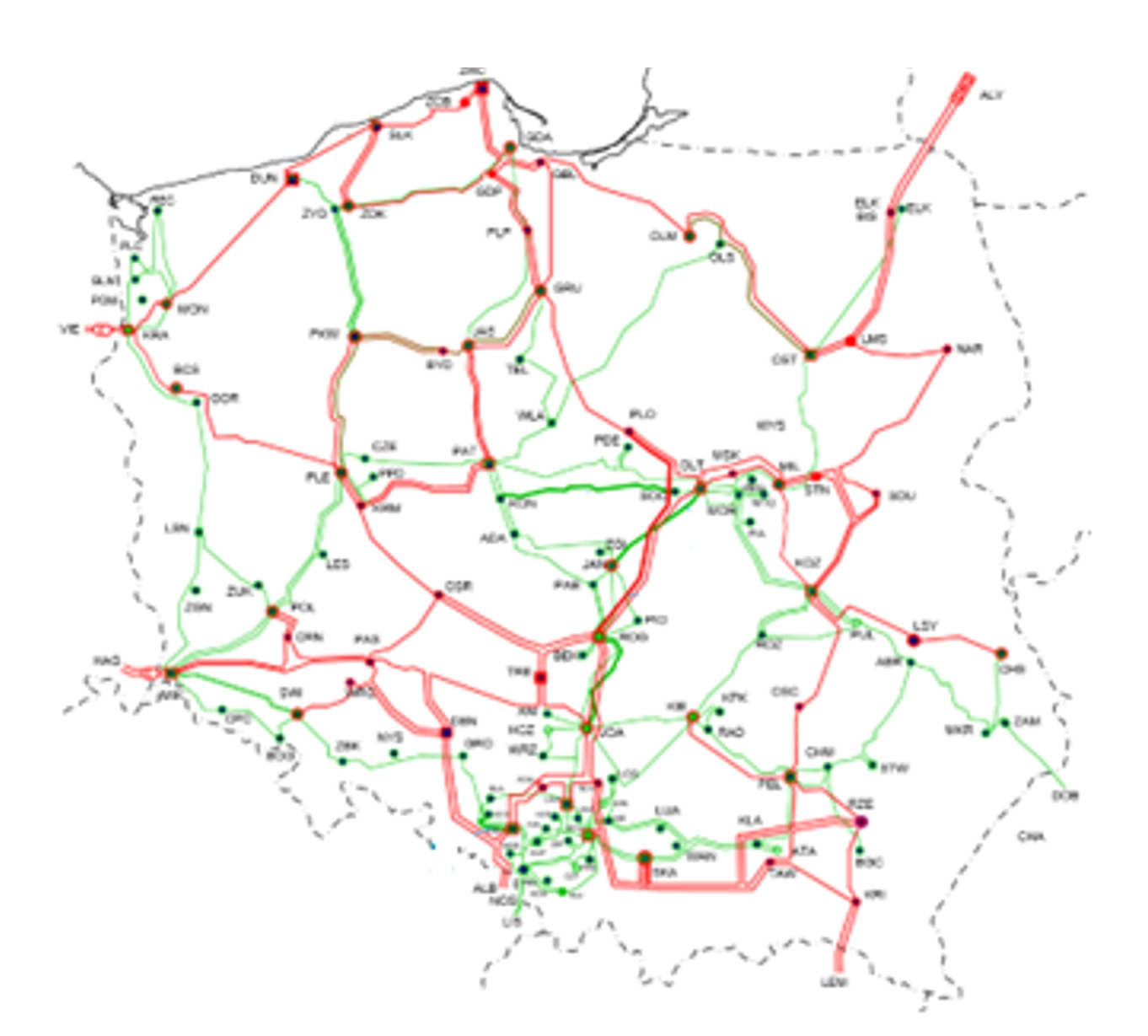
Fig. 2 is shows a map of Poland with location of existing in 2021 overhead transmission electric power lines – 220 kV (in green) and 400 kV (in red). According to requirements of international and Polish standards the entire transmission line shall be protected against lightning damages by shielding ground wires creating the protective zones. The required shielding angle for external line conductors shall be ≤ 20o for single circuit line while in case of double circuit line the angle shall not be greater than 45o. Many transmission lines in Poland have ground wires incorporating the optical wire – OPGW.
For effective lighting protection of overhead transmission lines, the important role plays the grounding system of towers and its maximum resistance to earth. In Poland generally it shall not exceed the value of 15 Ω if soil resistivity ρ<1000 Ωm or 20 Ω when ρ>1000 Ωm.
Drawings of typical existing metallic towers used for construction of 220 kV and 400 kV transmission lines in Poland are shown in Fig.3.
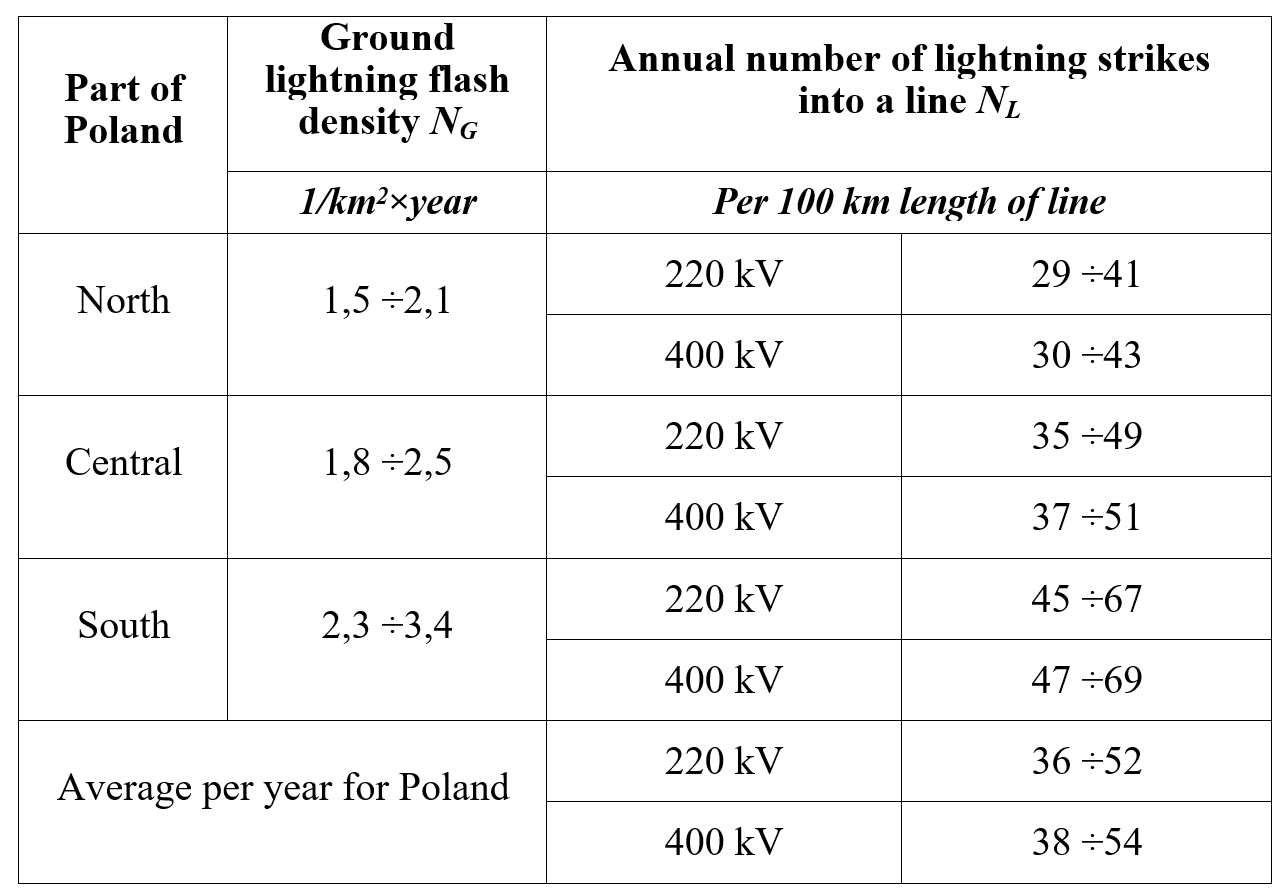
Estimated numbers of annual lightning strikes NL in 220 kV and 400 kV per 100 km length of line for Poland (typical unit length of line for lightning performance analysis of transmission lines) using equations (1÷3) and are shown in Table I.
When taking into account the average sag of shielding ground wires between spans the average height of the typical line tower may be lower by app. 10%. Thus may reduce the estimated number of lightning strikes given in Table I within the same range depending on the line nominal voltage and line configuration.
Typical heights of 220 kV line towers are H = 28 ÷ 30 m, while for 400 kV line towers are higher – H = 30 ÷32 m. Assuming that the typical width W of tower highest grounded construction parts is W = 12 ÷ 18 m one can estimate the expected number of direct strikes into the line per 100 km length/per year based on formula in Ref. 2. Results of such estimations are given in Table 1, assuming that lightning flash densities are varying in given ranges for different regions of Poland.

Analysis of Shut-downs & Disconnections of 220 kv and 400 kv Lines Caused by Lightning
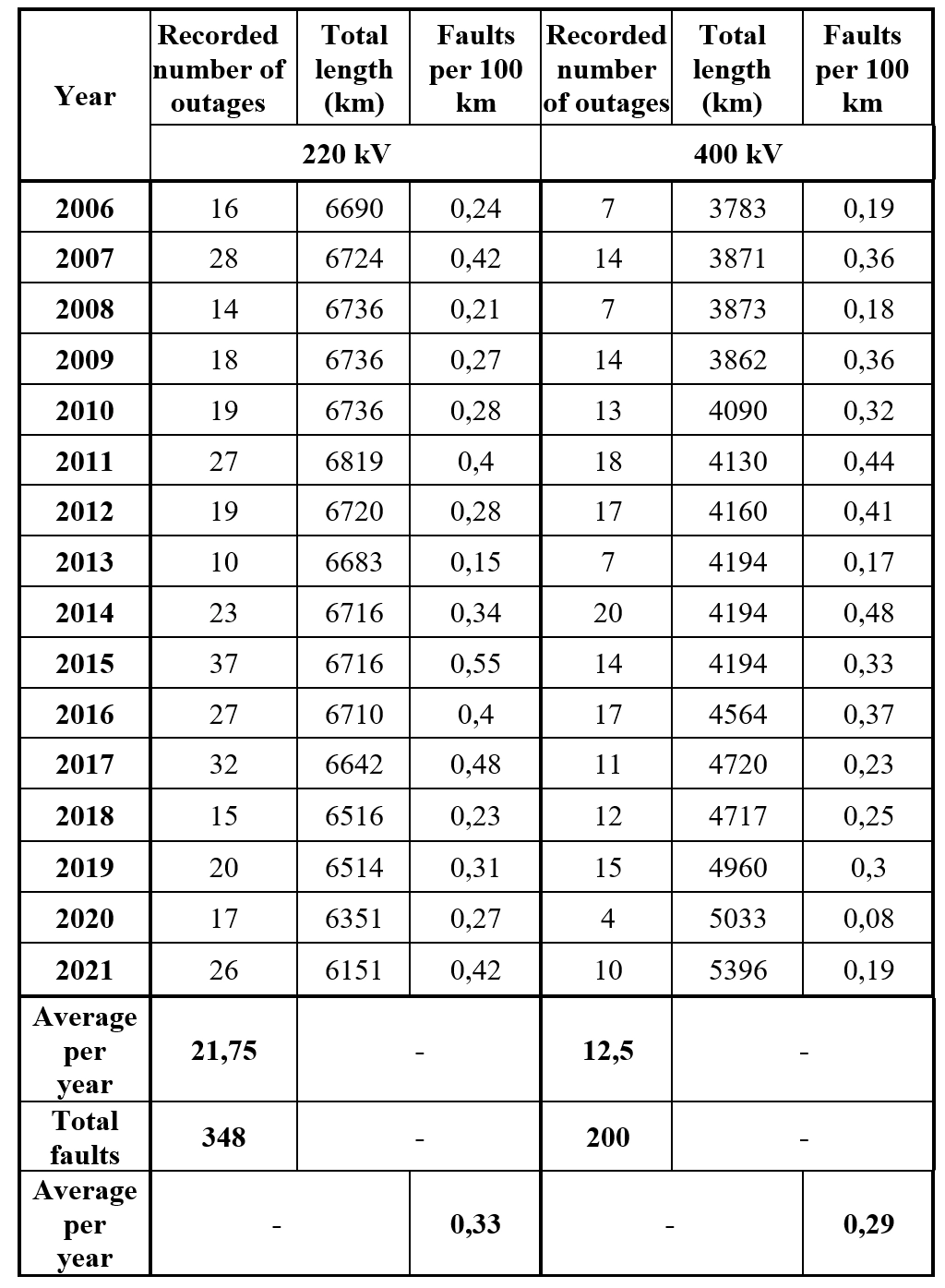
The total length of HV transmission lines in Poland is presented in Table 2. In period from 2006 to 2021 total length OHL in Poland changed. This information is important, if we will analyse the total faults line per 100 km line length/year.
A. Statistcs of Lightning Outages of OHL
The number of lightning outages of 220 kV and 400 kV transmission lines recorded by the operator – PSE in years 2006 – 2021 are shown in Table 2 and in Figs. 4, 5 and 6.
Shutdown of line was defined as an event when fault clearing and the automatic reclosures were not successful in 1 minute from the recorded fault time. The automatic successful reclosure means that the line started to operate immediately after the lightning event.
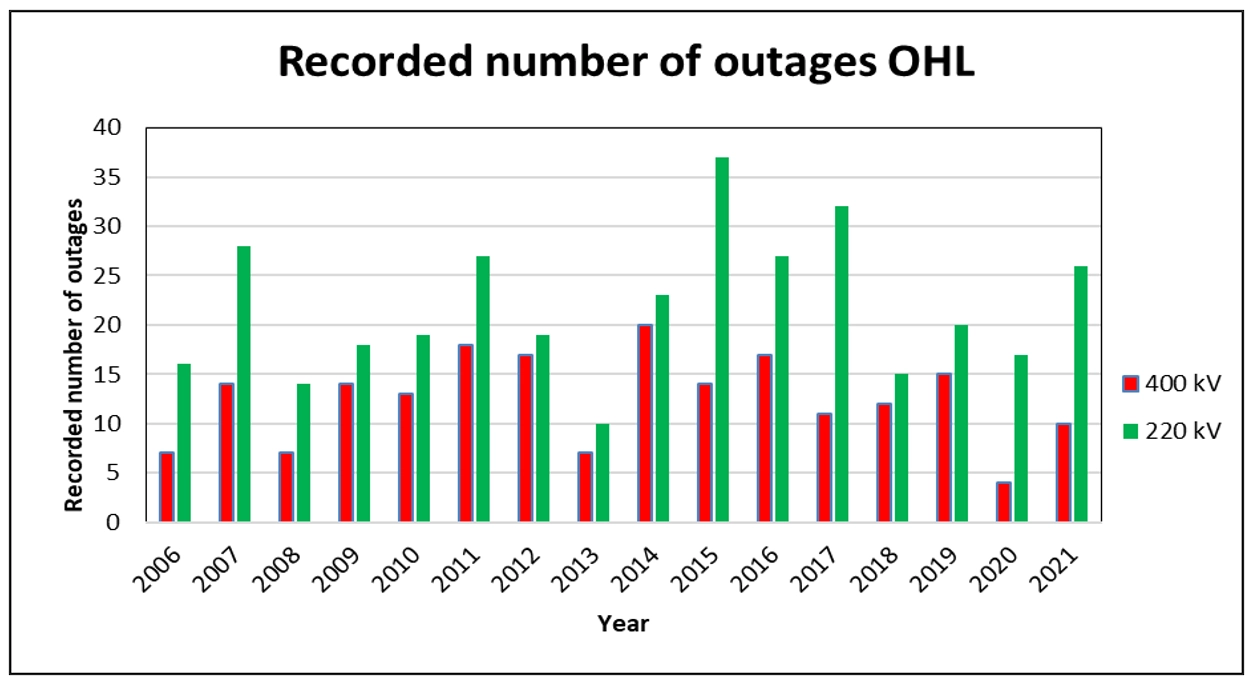
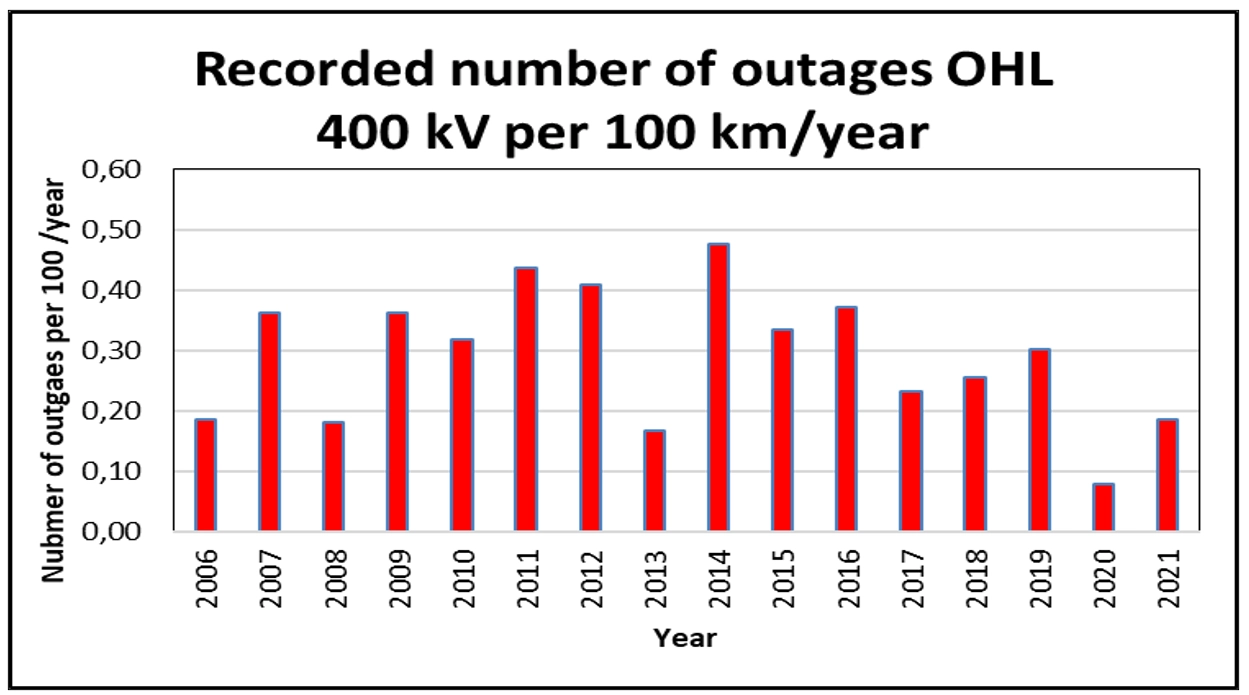
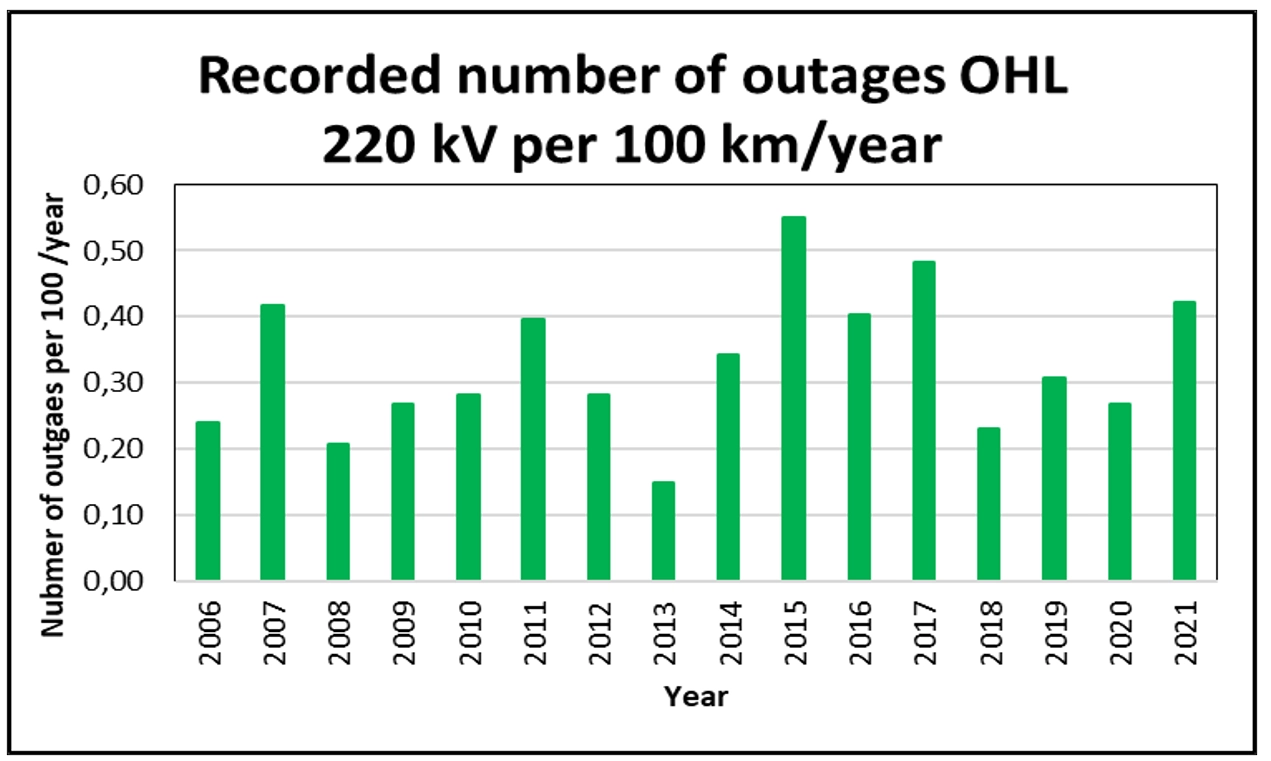
Majority of recorded faults due to lightning strikes were the automatic reclosures, while duration of shutdowns was extended in individual cases up to several hours.

B. Statistcs of Lightning Activity in Poland
Years 2011 and 2015 recorded the highest numbers of outages of OHL while the lowest were in 2013 and 2020.
In Fig. 7 is shown the lightning flash density map in high resolution area [1 km x 1 km] recorded by LINET in subsequent years 2008-2015. Based on yearly reports delivered by LINET to Gdansk Technical University, where one LINET system antenna is located, it was created the map shown in Fig. 7. There is one of the valuable sources for assessment of Ng value – the fundamental parameter of lightning risk – necessary also for overhead transmission power lines.
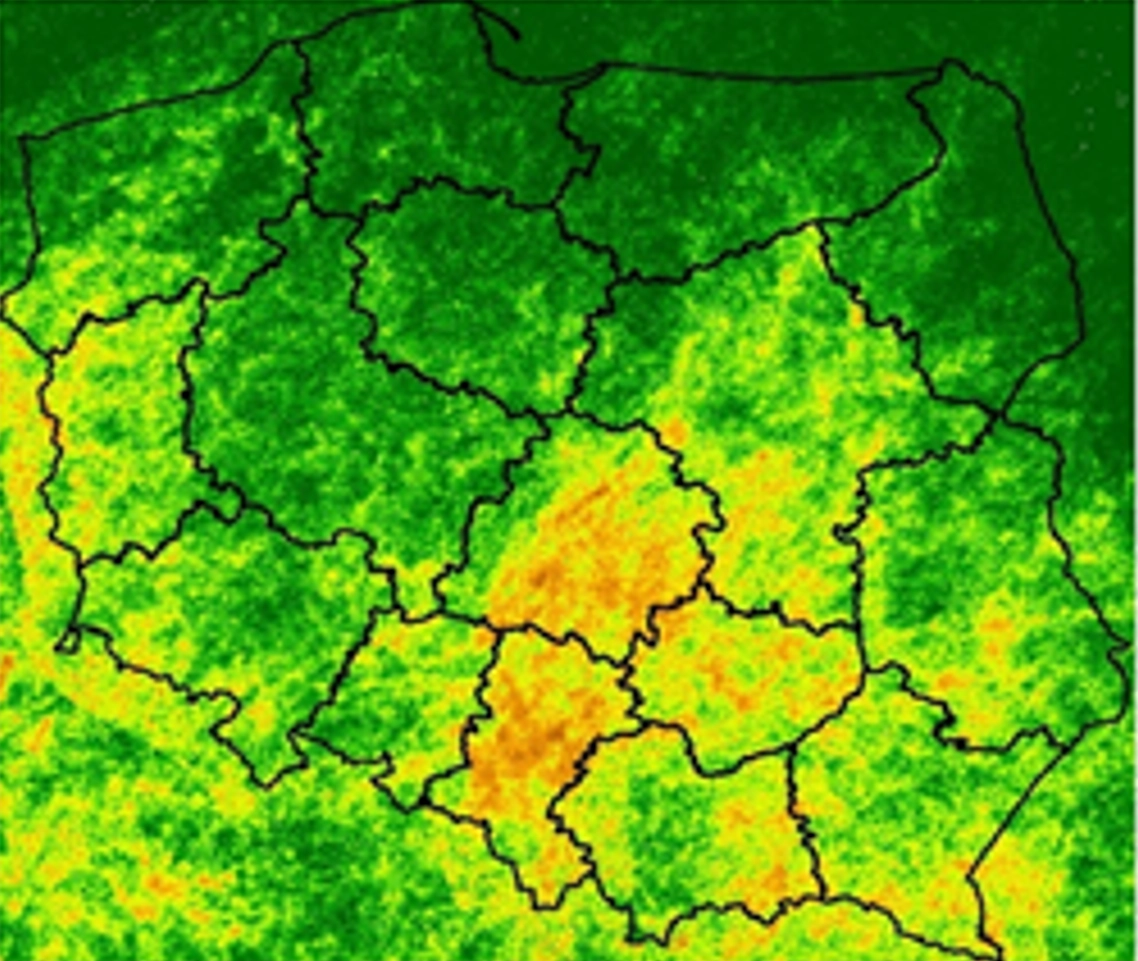
The total number of CG discharges and Ng values have been seriously varying in individual years of period being analyzed as well in individual months of each year. Exemplary monthly variations of number of CG lightning flashes in 2008 (beginning of analyzed period) are shown in Table 3.
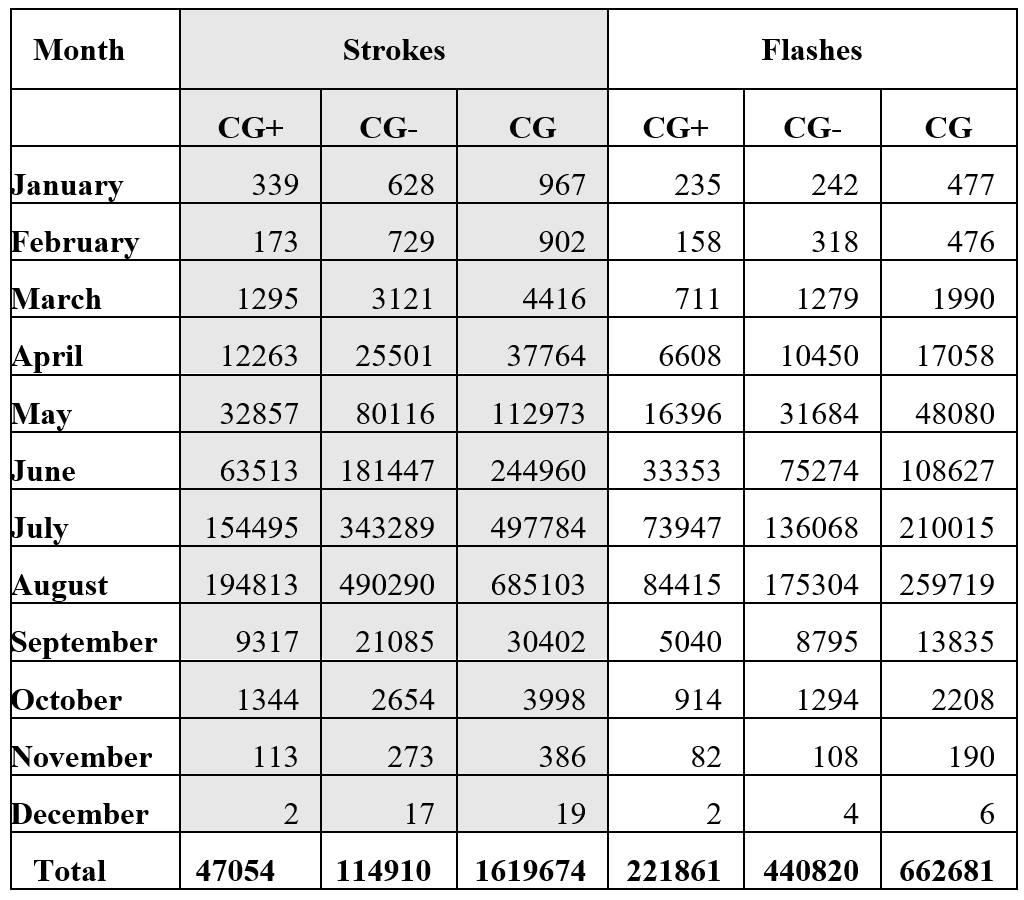
Comparing numbers of recorded by LLS lightning CG discharges individual years with estimated number of calculated annual lightning strikes NL in 220 kV and 400 kV lines presented in Table 1 it is possible to assess the probability P that the direct lightning strike in the transmission line will cause any kind of fault (shutdowns or reclosures) with different economic effects. This probability can be defined as:

For HV transmission system in Poland, estimated values of average annual probability P of lightning fault of HV line based on PSE data in years 2008-2013 are:
– for 220 kV lines, P = 6.4 · 10-3 ÷ 9.2 · 10-3,
– for 400 kV lines, P = 5.4 · 10-3 ÷ 7.6 · 10-3.
This means that the efficiency of lightning protection measures installed is high and for climatic conditions of Poland the lightning damage risk of HV transmission line is rather moderate.

Conclusions
This article describes statistical data of HV transmission lines lightning performance in years 2006-2021 in Poland.
The analysis of estimated frequency of 220 kV and 400 kV lightning exposure and comparison with recorded by transmission system operator line outages shows that the probability of lightning outage in Poland is moderate and varies in range 5 ·10-3 ÷ 9 ·10-3.
In general, the lightning protection system of lines is quite efficient and damages of line insulation are not very frequent in Poland especially taking into account the total length of lines. This is mainly due to fact that majority of transmission lines are in flat topological areas and at low altitudes and characterized by lightning flash density Ng in range of 1.5 ÷3.4 flashes/sq.km year.
Effective information for real lightning performance overhead transmission lines are data from LLS on lightning intensity in the area of line location.
References
[1] LINET – www.nowcast.de
[2] IEC 62305-2 –Protection against lightning – Part 2:Risk management. Ed.2:2010
[3] M. Loboda, H. D. Betz, Z. Dziewit, P. Baranski: ”New lightning detection networks in Poland – LINET and LLDN”, 29th International Conference on Lightning Protection – ICLP 2008, Uppsala, Sweden 2008.
[4] PSE SA data
[5] W. Skomudek: „Analysis and Assessment of Overvoltage Effects in Medium and High Voltage Power Networks” (Analiza i ocena skutków przepięć w elektroenergetycznych sieciach średniego i wysokiego napięcia), Politechnika Opolska, Studia i monografie, z. 225, Opole 2008 (in Polish).
[6] PN-EN 50341:2012 – Overhead electrical lines exceeding AC 1 kVPart1: General requirements – Common specifications.
[7] Z. Flisowski, M.Loboda, G. Maslowski, S. Wojtas; Main Outlines of Lightning Research Development in Poland, 34th ICLP, 02-07 September 2018, Rzeszow Poland.
[8] Private communications with Prof. H.D. Betz – nowcast.de