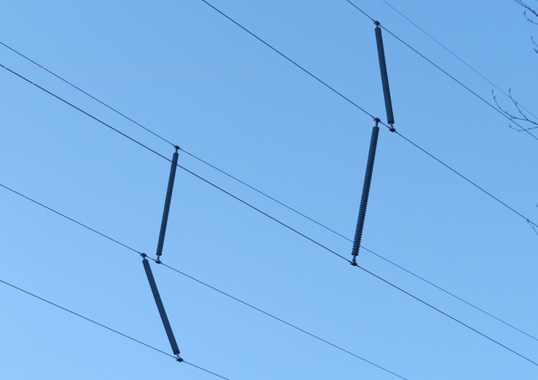

Insulated cross-arm assemblies with composite insulators have been used on HV transmission systems for decades. One affirmation of this has been the use of line post insulators as per IEC 61952 and braced post solutions based on line posts supported by tension insulators (as per Guides such as IEEE 1572). However, line post and braced post solutions have limitations related to their low longitudinal forces withstand capabilities. Such solutions are therefore dominant in dense urban areas, where establishing ROW paths has become a challenge when meeting growing power supply needs in large cities. Due to these mechanical limitations, it is more usual to find such applications only at voltage levels up to 230 kV, with some exceptions.
Use of three or more composite insulators to design an insulating cross-arm able to withstand longitudinal forces of the types present on most lattice type towers is a more recent development. Still, it has now become a ‘disruptor’ in tower and line design, with a clear impact on transmission line compaction and uprating possibilities to existing towers. The renewed interest in this ‘old’ idea relates largely to growth in experience and knowledge of composite insulators. As a result, insulated cross-arms of this design can withstand tri-axis forces on lines above 230 kV and even up to UHV levels.
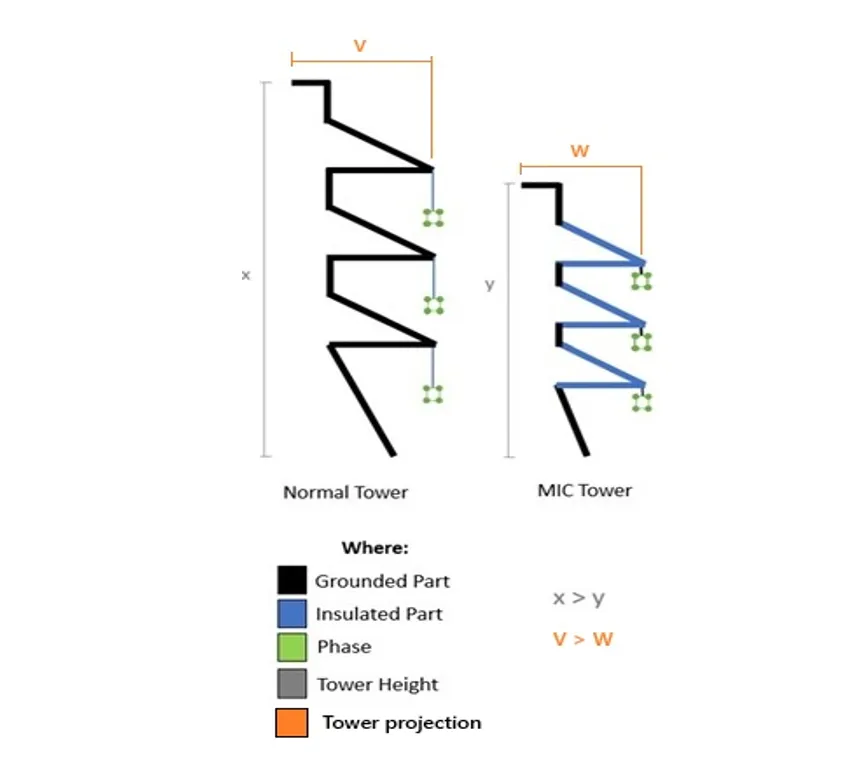

This insulating cross-arm application is now starting to be studied within the power community to generate deeper knowledge on design concept, relevant electro/mechanical considerations and adequate testing to cover all new requirements related to the impact of this technology on TL design.
Plan to participate at the 2025 INMR WORLD CONGRESS in Panama from Oct. 19-22, 2025. Adriano Dellallibera of Hubbell-Balestro will present results from development and testing of a molded composite insulator crossarm assembly for 230 kV system voltage in Brazil. He will also explain why, although use of composite insulators is widespread in HV, EHV and UHV, application of these insulators on tower cross-arm constructions requires understanding their behavior as a mechanical tower component over and above their basic insulating function.