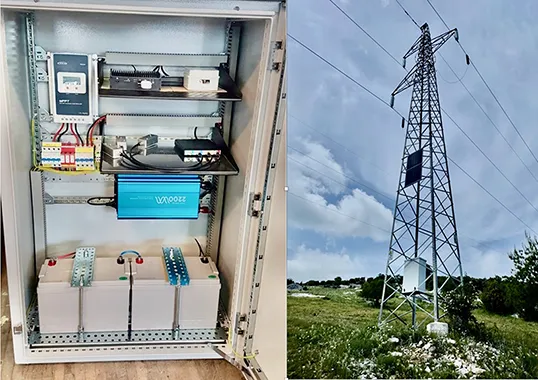
Performance of overhead transmission lines (OHL) is significantly influenced by lightning activity, which is one of the primary causes of line outages and power system disturbances. To design efficient protection strategies, it is essential to understand the characteristics of lightning currents, including parameters such as peak current, front duration, tail duration, maximum current steepness, charge transfer, and specific energy, as outlined in CIGRE Brochures 549 and 855.
Improving lightning performance of OHL can be achieved through various measures, such as enhancing tower grounding systems, increasing critical flashover voltage (CFO), applying grounding wires and installing line surge arresters (LSAs). Among these, LSAs are particularly attractive due to their cost-effectiveness, ease of installation and proven ability to reduce lightning caused flashover rate.
Monitoring of lightning currents flowing through LSAs and transmission towers is crucial for obtaining detailed insight into lightning parameters, validating flashover rate calculations (e.g., with EMTP-like software), and specifying discharge capabilities of arresters. While lightning locating systems provide valuable data such as stroke time, 2D GPS coordinates, amplitude, and lightning type, they are unable to capture the detailed current waveform, especially the front and tail times. These are essential for insulation coordination studies and understanding energy stress on arresters.
Recent advances in electronics, communication networks, and particularly Industrial Internet of Things (IIoT) technologies have opened new possibilities for development of embedded monitoring systems that operate in real time. These systems allow continuous measurement and transmission of high-resolution data from LSAs and towers, enabling advanced data-driven analysis, predictive maintenance and improved decision-making. Numerous systems for measuring lightning currents have been implemented worldwide (e.g. in Japan, Switzerland, Canada, Austria). However, most are installed on tall telecom towers rather than on OHL, which limits their direct applicability to transmission systems.
Plan to participate in the 2025 INMR WORLD CONGRESS this October in Panama. Dr. Selma Grebović at the Faculty of Electrical Engineering at the University of Sarajevo in Bosnia and Herzegovina will build on experience with real-time monitoring of transient lightning currents in the Croatian transmission network, to present advancements in design of modern measurement systems that leverage IIoT technologies. These systems combine high-precision sensors, robust communication modules and cloud-based analytics to enhance system protection, increase equipment service life and improve grid resilience. She will also explain how, given a sufficient number of monitoring systems and a large dataset of operational measurements, integration of artificial intelligence and machine learning enables advanced predictive analytics, anomaly detection and automated optimization. These developments mark a significant step toward building intelligent, self-learning power networks and serve as a foundation for future smart grid applications.