Much has been discussed and written through channels such as INMR, IEEE, CIGRE and other technical communities about the performance of silicone coated insulators. Currently IEC is working on an important new standard (future IEC 63432) to establish a consensus for formal procedures and testing protocols based on the large, accumulated mass of testing and field experience gained over decades.
Hydrophobicity Transfer & Recovery Properties
These two terms are sometimes used interchangeably. By nature, hydrophobicity is a unique property of silicone materials that can be assimilated to water repellency. For materials such as silicone, this property is dynamic and can evolve as a function of environmental stresses. For example, when a silicone surface is subjected to continuous dry band arcing or corona activity this hydrophobicity is lost. Sometimes this loss is permanent but more typically hydrophobicity can recover after some time. This is termed the ‘recovery’ property.
Similarly, once a silicone insulator is exposed to external pollution, its surface is progressively covered by dust or other environmental pollutants. While the crust of pollutants is itself not usually hydrophobic, the bulk silicone contains low weight molecular species with the ability able to migrate through the pollution layer and render it hydrophobic. This is known as the ‘transfer’ property.
The transfer property is of course key in why silicone is an interesting material for polluted environments. Without it, silicone would be unable to perform differently from glass or porcelain surfaces. Nonetheless, there is an important consequence of this property when it comes to evaluating the pollution layer over a silicone surface. Since the pollutant is progressively encapsulated by the silicone bulk material, a correspondingly reduced amount of pollutant is collected when measuring ESDD/NSDD.
A recent study performed at the Sediver Research Center showed that RTV silicone coated insulators have a slightly faster transfer time than commercially available HTV silicone used in many polymer insulators. This is the result of structural differences between the two chemistries. Fig. 1 shows test data from surfaces polluted with Kaolin at ESDD=0.1mg/cm² and NSDD= 0.2mg/cm².
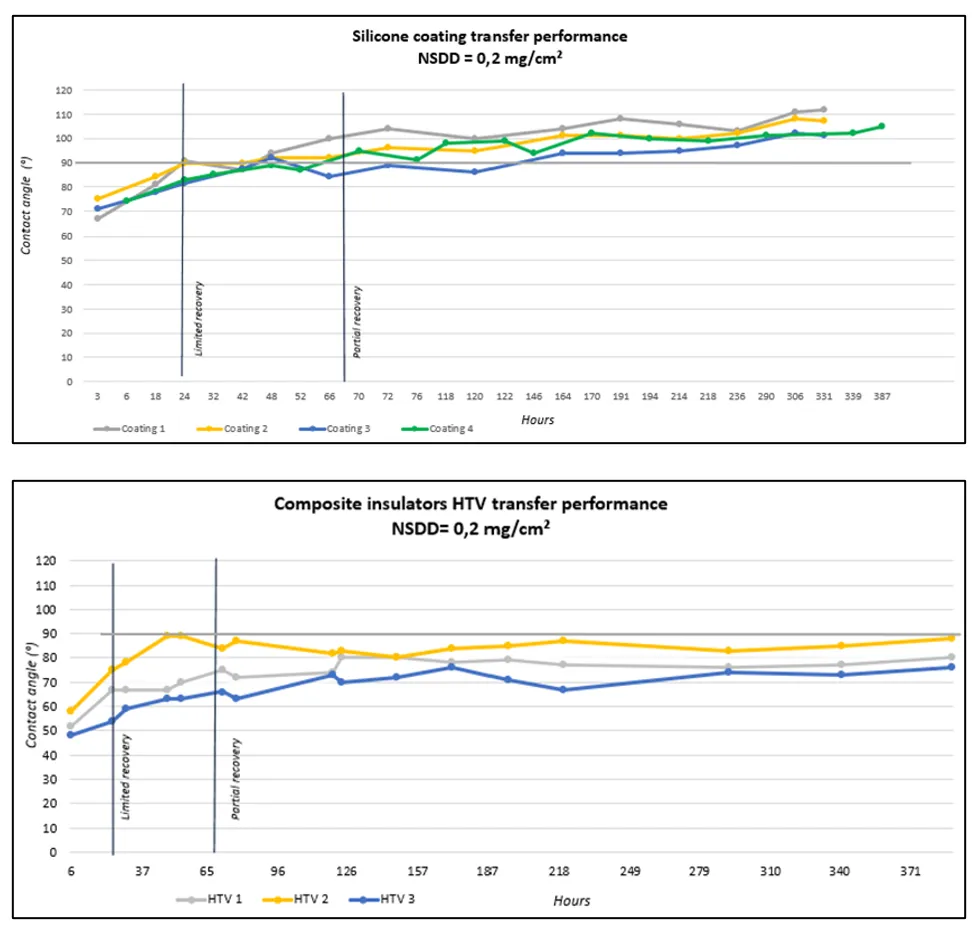
As a matter of fact, the upcoming IEC 63414 standard describing test procedures for artificial pollution tests on HTM insulators stipulates that a solid layer pollution test must be performed within 24h after deposit of the layer if the goal is to determine performance of an insulator with limited recovery and within 64h to 68h for such a test with partial recovery.
Upcoming IEC 63414 also contains a provision about maximum NSDD level to consider for testing. If Kaolin is used, this limit is NSDD=0.25mg/cm² and with Tonoko it is NSDD=0.4mg/cm². Tonoko less impacts conductivity of the pollution layer on the surface of an insulator than does Kaolin. This is important with respect to demands made by some engineers who want artificial pollution testing performed with very high NSDD levels, e.g. sometimes above 1 mg/cm² or even 2 mg/cm².
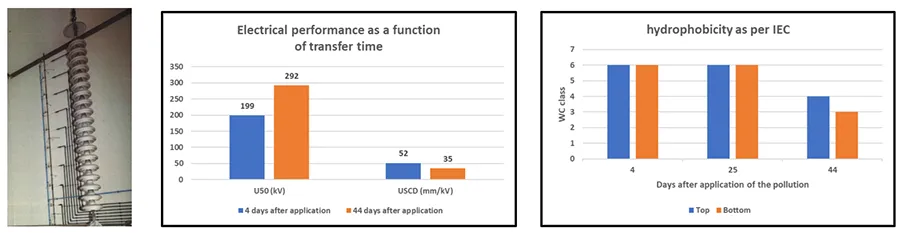
Unfortunately, it is not realistic to produce such tests because the transfer cannot take place in such a time scale. It is therefore not representative of reality where, in the field, pollution accumulates progressively, and hydrophobicity rebuilds itself progressively as well. The example in Fig. 2 illustrates these dynamics at play in the pollution layer with an evolution of performance over time of approximately 25% over a period slightly longer than 1 month.
Plan to attend the upcoming 2025 INMR WORLD CONGRESS in Panama. Jean-Marie George, Scientific Director at Sediver will make a technical presentation to address frequently asked questions about application of RTV coatings to glass insulators. These will include, among others:
• Understanding the effect of transfer properties when discussing pollution testing.
• Measuring ESDD/NSDD on silicone surfaces given the encapsulation taking place and transfer of hydrophobicity to the pollutants.