High voltage insulated cable lines have become the preferred choice for large urban areas due to lower community impact and less vulnerability. Moreover, despite costs that are typically 5 to 10 times higher than for compact overhead lines of the same capacity, they often represent the only feasible solution. While less exposed to external factors and extreme weather, failures in underground or submarine cables can be relatively difficult to locate and could require a week or more to repair. Impact on system reliability can be significant.
It is therefore essential to apply lessons learned, consider regional conditions, and strengthen asset and risk management for new cable projects. Continuous monitoring and detailed analysis of past failures can help in this regard. Shared utility experience combined with standardized repair practices and advanced diagnostics will support optimized operation, prevention of recurring problems and reduced life-cycle costs.
This edited contribution to INMR by HV cable expert, Carla Damasceno, in cooperation with engineers at Light, Prysmian and ISA, reviews data on failures of insulated cables in urban areas served by the major distribution companies in Rio de Janeiro and São Paulo. The analysis covers outage duration, main cause, and system impact. Results from this work lead to recommendations to enhance reliability and guide contingency planning for high voltage underground cable lines.


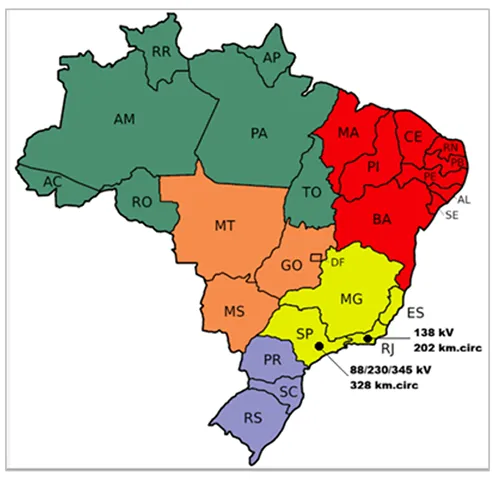
Data were collected from distribution and transmission utilities covering performance of high-voltage systems in Rio de Janeiro and São Paulo during the period 2012 to 2022. The voltage class of these insulated systems ranged from 88 kV to 345 kV. Results for these 3 Brazilian utilities were then summarized to provide an overview of number of failures, annual frequency, duration and unavailability.
Information collected included system length, number of occurrences, expected line length, and associated downtime for each year, as well as identification of individual lines involved in failures, their voltage level, cable type, failure duration, cause, and impact. Among the causes evaluated were:
• system operation,
• overvoltage,
• overload,
• influence of protective device,
• external mechanical damage,
• vandalism,
• material stress,
• poor accessory assembly, and
• ageing.
Data was then analysed and presented in the form of Tables and Charts to better visualize trends in failure frequency, duration, unavailability, and system impact. This allowed a comprehensive overview of performance of underground high voltage cable systems and served as the basis for reliability assessment and contingency planning.

Assumptions & Calculations
After reviewing the data provided by the 3 utilities, some information was deemed missing, i.e.
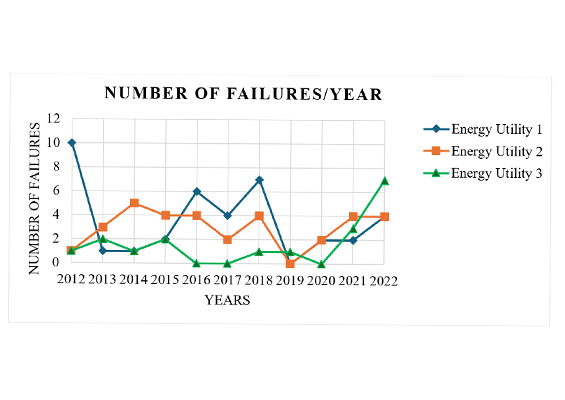
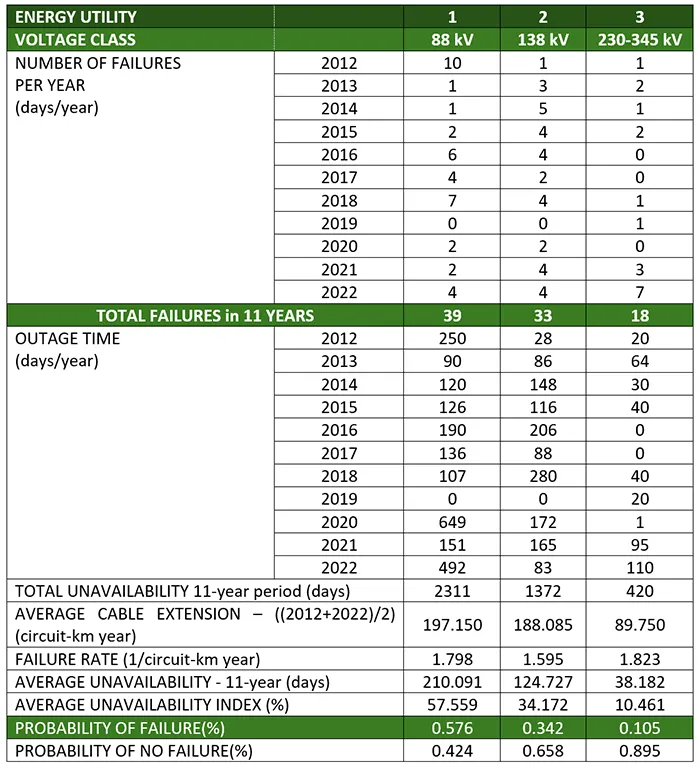
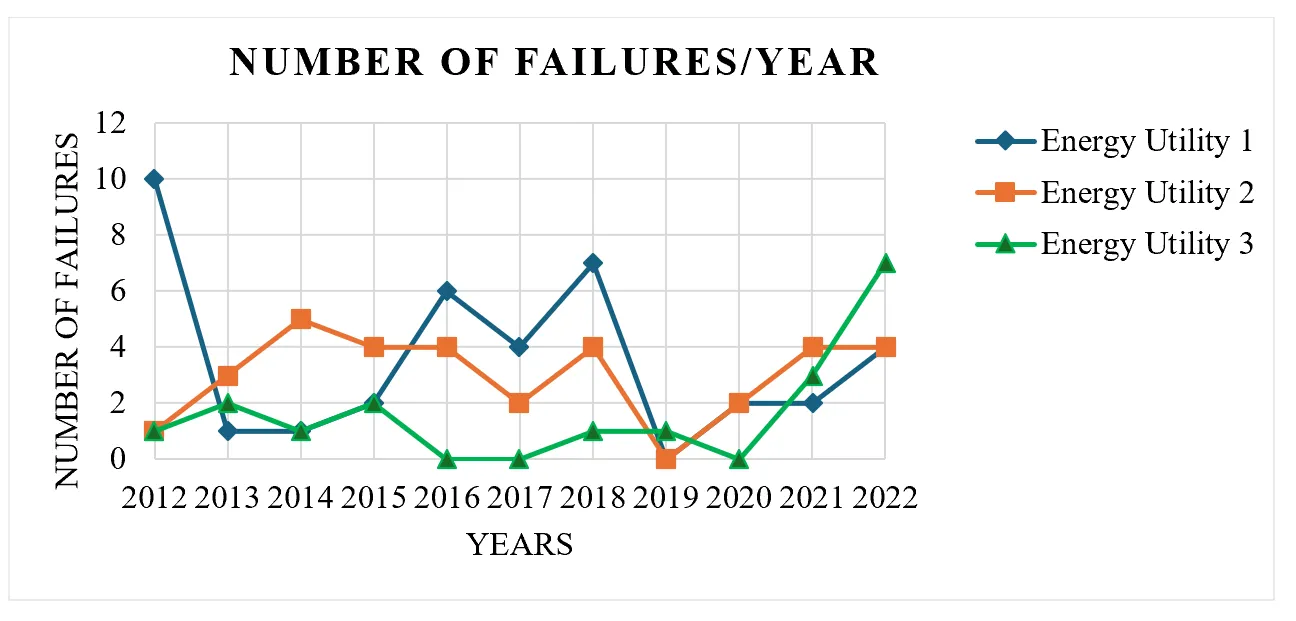
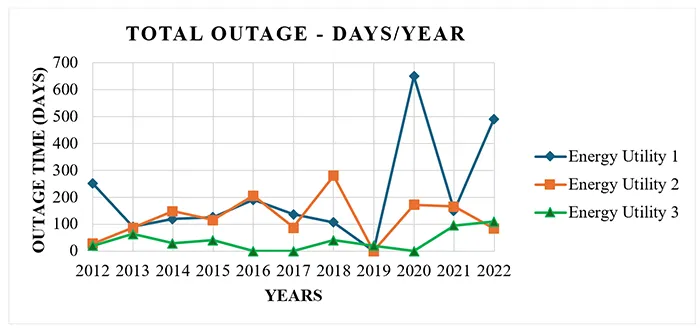
1. Not all the energy utilities completed the questionnaire with regards to quantity of joints and terminations. As such, the corresponding numbers of failures were included in failure rate calculation as cable failure. In addition, there was no data available about cable line length under failure. Fig. 2 presents total number of failures per utility and Fig. 3 shows duration of outages.
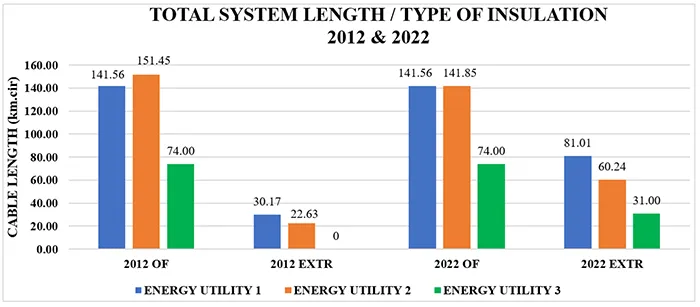
2. The underground cable system extension was only available for the first year (2012) and last year (2022). Therefore, for the entire 11-year period, an average of these two years was considered in calculating failure rate (see Fig. 4).
3. The questionnaire did not include information about insulation type in the case of extruded cables. Therefore, this classification was not included in the survey. However, it is known that there are only a few EPR cables probably included in the fault list, while the majority are XLPE. Fig. 4 considers only oil fluid filled as well as extruded cables.
4. Utility 2 is alone in having 4-line sections totalling 2 circuit km. in length that crossed a sea channel. Since their respective lengths were not significant compared to the entire underground system and recorded no failures during the period studied, these were not considered in this analysis.
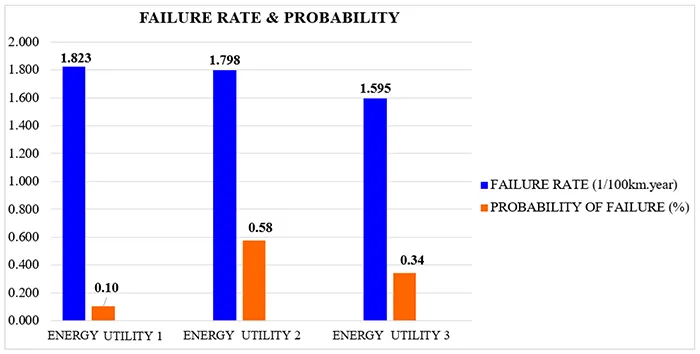
To process data, CIGRE TB 815 formulas were utilized to calculate failure rate, average unavailability index, failure probability, and probability of no failure (see Table 1).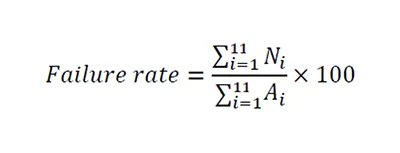
where:
Ni = Number of failures considered for 11 years
Ai = Quantity of the sum cable system in service considering the average circuit-km multiplied by 11 (total number of years observed)
NDmed = ND/11
INDmed = NDmed = ND/11
INDmed(%) = (NDmed/365) x 100
P(F)(%) = INDmed/365 = [INDmed(%) x 365/100 ]/365 = INDmed(%)/100
p(N) = 1 – p(F)
The probability of the cable being in operation, or reliability:
p(N) = 1 – p(F) = 1 – INDmed(%)/100
where:
ND = number of days per year under fault in the 11-year period
NDmed = average number of days per year under fault
INDmed = average unavailability index
INDmed(%) = average unavailability index in percent
P(F) = probability of cable being under fault
P(N) = probability of cable being in operation
Fig. 5 presents trends in data and parameter calculations derived from completed questionnaires covering the period 2012 to 2022.

Analysis of Data
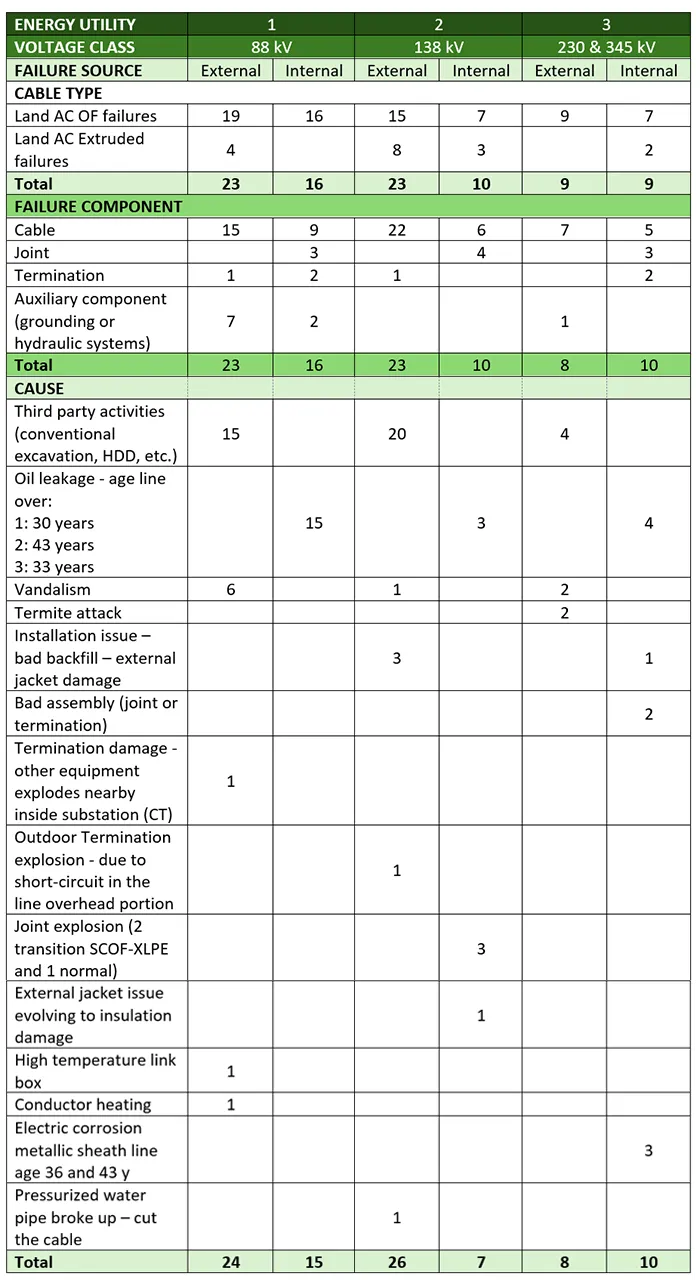
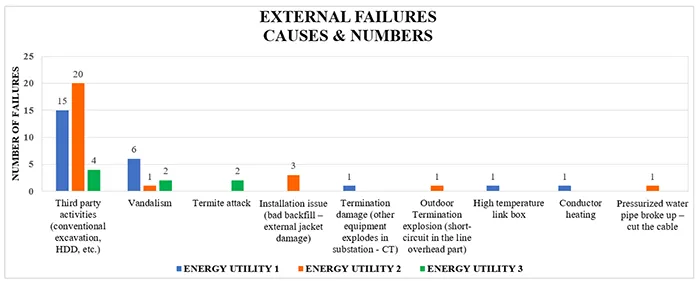
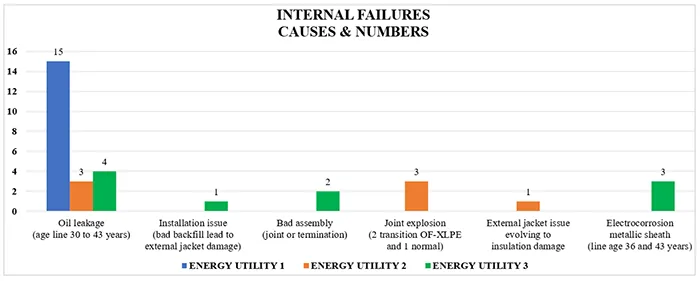
Analysis of the faults in Table 1 and in Figs. 6 & 7 revealed several findings:
a) Total length (in circuit-km) of the underground cable system for each Utility is detailed in Fig. 4. As can be seen, only new XLPE cables were installed during this 11-year period. However, it is important to note that approx. 70% of all existing cable systems are still the self-contained oil-filled type.
b) Among all failures, 64% were external while 36% were internal. These results are virtually the opposite of what is stated in TB 815. Comparing these findings to results for the period from 2001 to 2010, reported external failures increased by 4% while reported internal failures decreased by 4%.

c) 67% of significant external failures are attributed to third-party mechanical damage, followed by 16% due to vandalism. Interestingly, the major cause of external failure, as highlighted over the previous 10 years, were similar, i.e. with 62% attributed to third-party activity. Technical Brochure 815 corroborates this trend, with the major cause of external failure of cables being third-party mechanical activity.
d) The main cause of internal damage was oil leakage (totaling 61%), which related to self-contained, oil-filled cables (SCOF). This correlated with age of lines, which ranged from 30 to 43 years.
e) Failure rate, calculated over the 11-year period, was directly proportional to number of failures and inversely proportional to size of the underground system at each utility. Utility 3 experienced a lower number of failures. However, its failure rate was higher due to its relatively smaller size versus the other two utilities. Comparing results against the previous 10-year period, utilities 1 and 2 reduced failure rates, whereas utility 3 experienced an increase in failure rate.
f) In 2020, Utility 1 experienced the longest power line interruption time, lasting 649 days. The utility stated that one incident was particularly unusual: in one of the damaged underground lines, a power reclosing operation caused additional damage, significantly prolonging fault-location time. Moreover, this incident occurred during a critical moment of the COVID-19 pandemic, when the utility was operating with reduced work teams due to personnel being sidelined (particularly experienced assemblers over 60 years old involved in underground line repair).
It is worth noting that during this prolonged outage, Utility 1 also experienced 4 other incidents on more critical lines. Consequently, the utility prioritized those lines over the first, since the load was supported by a secondary circuit. In addition, it is speculated that reduction in work teams, including route inspections, meant that there was an increase in incidents caused by third parties.
g) It should be noted that manufacture of high voltage cables (up to 138 kV) in Brazil was discontinued in 2017. However, production resumed in 2022. Consequently, during this interval all materials took longer to arrive since they were imported regardless of voltage class. It is also worth noting that domestic production of high voltage cable accessories does not currently exist in Brazil.

Conclusions
Construction of new overhead lines in Brazil’s large urban centers has become difficult due to factors such as population density, limited availability of land, and social as well as environmental concerns. At the same time, there is growing interest and public support for installation of high voltage underground cables, which are less susceptible to severe weather. Customers, especially in urban areas, are increasingly demanding high quality energy supply indicators and will not accept high numbers of power interruptions. Growing concern about reliability of power systems is leading towards more underground cables, which offer high reliability and lower losses than overhead lines, despite longer repair times in case of failure.
It is important to highlight, record, and share data among energy utilities to improve reliability of underground cable systems. Energy utilities need to be vigilant about the causes of failures in their networks. They must monitor their evolution and proactively seek root causes of problems to anticipate trends and prevent failures from re-occurring.
Several recommendations are provided to mitigate occurrence of failures in high voltage insulated power systems:
• Plan appropriate designs, infrastructure, and installations for each new line alternative to reduce probability of failures, considering past lessons learned;
• Conduct regular inspections along cable routes to check for evidence of third-party activity and verify function of the hydraulic system in the case of oil-filled type cables;
• Optimize maintenance preventively;
• Undertake effective investigation and record-keeping of failure data;
• Establish minimum spare parts for cables and accessories to be stored in case of faults, considering potentially long delivery times, as is the case in Brazil;
• Utilize annual maintenance contracts for infrastructure work and deploy only specialized electromechanical workers in case of line faults;
• Analyze contingencies and take system operational measures;
• Exchange information, such as cable route records, among public service utilities.
Based on analysis of historic data, a significant number of networks have been affected by third parties and vandalism. It is vital utilities thoroughly analyze the cause of these occurrences and identify potential preventive measures to avoid risk to their energy systems.
It is also evident from past data that some failures last a long time. This is a worrying indicator since it confirms that the electrical system was exposed to risk of long-term supply interruption. It is necessary to work towards a process that can respond quickly and effectively, to minimize these risks. As mentioned, it is known that the greater operational reliability of underground systems contrasts with longer repair times when failures do occur. It is on this point that electricity supply utilities must focus preventive work to avoid failures. Should failures occur, companies must act such that repairs are completed in the shortest possible time, ensuring system reliability.
It is noteworthy that total number of failures and corresponding outage time for repair over the last 11 years decreased compared to the previous period from 2000 to 2009. During this latest period analyzed, land AC self-contained oil filled cable circuits saw a small reduction in line extension, while there was an increase in XLPE cables being installed, as expected. Another issue is that self-contained oil fluid filled cable lines are becoming older in Brazil and are more susceptible to failure.

Bibliography
[1] TB 815 – Update of service experience of HV underground and submarine cable systems,
September 2020
[2] TF B1.81 – RAG Report and questionnaire
[3] B1_110 Statistics of Failures on Underground High Voltage Power Cables in Brazil, Paris
Session 2010
[4] Reliability of Transmission Networks Impact of EHV Underground Cables & Interaction of
Offshore-Onshore Networks, Bart W. Tuinema, 2017
[5] B1_10760 Failure Statistics of High Voltage Underground Cables in Urban Areas – Experience
of the Southeastern Brazilian Large City Centers, Paris Session 2024