Over the decades, different designs and manufacturing methods have been applied for condenser graded bushings. Oil-impregnated paper (OIP) types are a mature technology and still the most widely used in transmission and distribution grids worldwide. But while these bushings fulfil all technical standards and performance requirements, they present risks such as potential loss of insulation media or accelerated ageing of their paper insulation due to overheating.
To avoid such risk, RIS type bushings are being adopted in harsh service conditions to increase safety of both transformers and reactors. This edited contribution to INMR by A. Doutrelepont, B. Heil and T. Schnitzler at Trench Group & HSP Hochspannungsgeräte in Germany elaborates the technological and physical advantages of RIS bushings.

RIS Condenser Bushings: Principle, Structure & Design
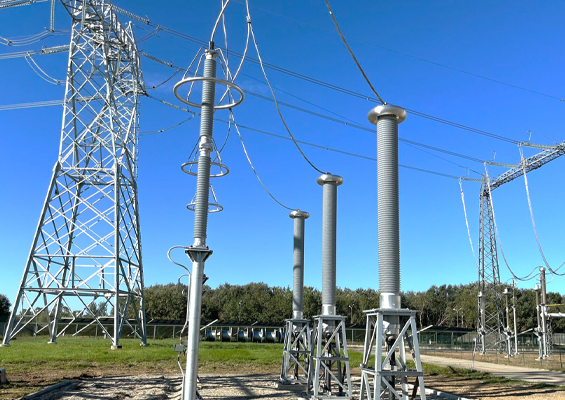
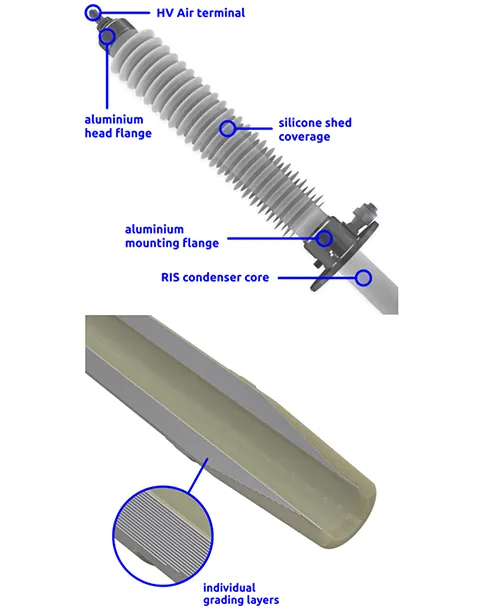
The main component of a high voltage condenser bushing is the active part or condenser core which, in case of RIS types, is a synthetic non-woven material. This serves as carrier for the epoxy resin in which concentric aluminum layers for the individual capacitors are allocated (see Fig. 1b). The condenser core ensures capacitance grading and is typically housed within a composite insulator covered by silicone rubber sheds, as in Fig. 1a.
The gap between composite insulator and condenser core is filled with a dry-type N2-based foam. Therefore, the bushing is completely dry and free of hazardous fluids and gases such as mineral oil, SF6, CO2, etc. RIS condenser bushings are more environmentally friendly than conventional OIP bushings and better in regard to LCA compared to RIP type bushings.

Functionality & Material Properties of Condenser Core
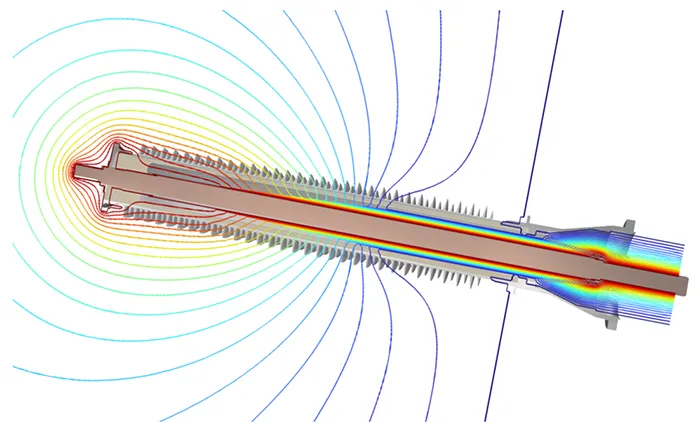
Under application of high voltage, a capacitance graded condenser bushing is capable to evenly distribute the electrical field, as illustrated in Fig. 2. This way, local electrical field stress is reduced and distributed over the entire length of the bushing.
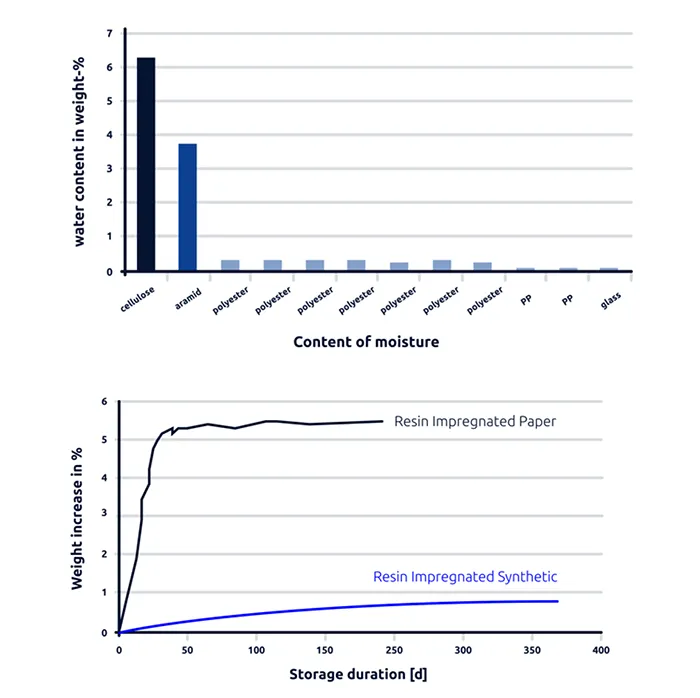
One of the main material advantages of an RIS condenser core is its non-hydroscopic performance. This ensures no ingress of moisture or humidity that would harm electrical performance under high voltage. This contrasts to paper, as used in RIP type bushings, which can easily accumulate humidity when exposed to the environment. This aspect is highly sensitive not only for the manufacturing process but also during installation, commissioning, and storage.
Fig. 3, for example, shows humidity absorption after storage in water. The results at 23°C and 50% relative humidity are 6.24% for paper but only 0.23 – 0.32% for synthetic materials.

Qualification of RIS Condenser Bushings
In fact, the only component of an RIS condenser bushing that is different from an RIP type is the synthetic carrier material for the epoxy resin and aluminum layers. Nonetheless, an extensive qualification program is required to ensure that all the beneficial aspects of the well-established RIP condenser bushing technology are maintained or improved.
As example, a thermal cycle test of RIS condenser bushings was carried out with dynamic mechanical and continuous electrical loads (see Fig. 4). The entire set-up was built inside a climate chamber that enabled 30,000 load cycles at 2500N and with ambient temperatures that varied between -60°C and +50°C (see Fig. 6). During the test, the bushings were continuously stressed with 80% of Up. At each temperature peak, all electrical parameters including capacitance, dissipation factor and partial discharge were measured. The bushings passed without failure.
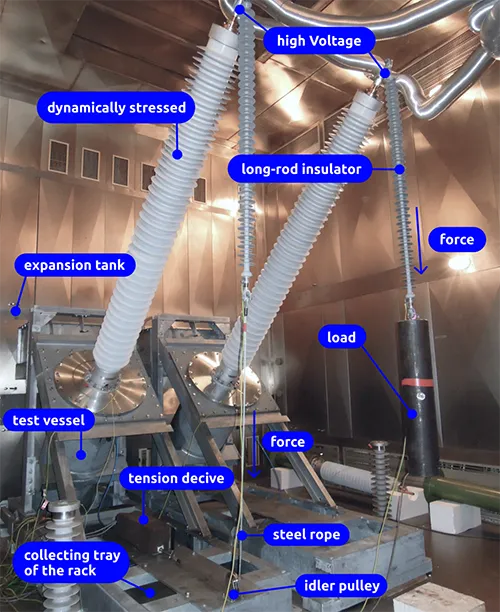
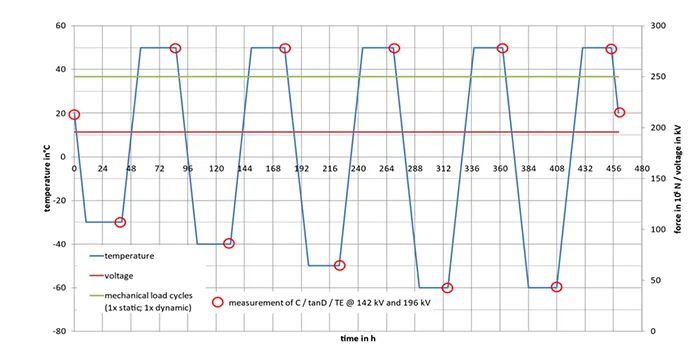
This test demonstrated that RIS condenser bushings cover low ambient temperatures down to -60°C as well as the same seismic requirements as do RIP condenser bushings. Moreover, comparative accelerated ageing tests in a long-term test laboratory confirmed that the life of RIS condenser bushings exceeds that of RIP condenser bushings.
The first RIS condenser core bushings were installed and commissioned in 2014. Since that time, more than 2000 such bushings have been put into service with a total of more than 50 million cumulative operating hours and with no reports of failure.

HVDC Condenser Bushings Using RIS Technology
Oil-immersed shunt reactors and power converter transformers are needed in HVDC grids and interconnections, and condenser bushings serve to connect such equipment. In this application, DC electrical stress leads to resistive grading in addition to the capacitive grading of AC electrical stress. Therefore, design and testing of HVDC condenser bushings has been elaborated and defined in specific international standards.
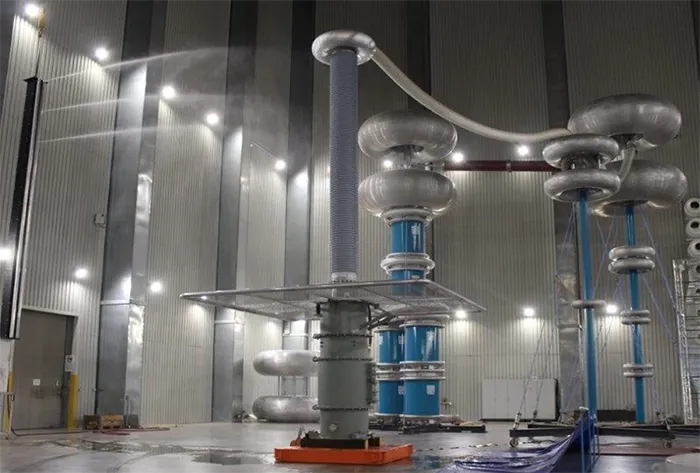
To verify the design capabilities of RIS technology for HVDC applications, extensive developmental testing was performed involving a 545 kV converter transformer bushing. Individual test sequences were carried out in parallel for RIS and RIP technologies. All applicable type and design tests were successfully completed in 2022. Fig. 6 shows the set-up of the even wetting DC voltage test.

Life Cycle Assessment
A factor of growing importance for both TSOs and public utilities is environmental impact and use of eco-friendly components and equipment. One of the validated methods to determine the CO2 impact of individual products is life cycle assessment. With this, carbon footprint can be calculated all the way from initial sourcing to manufacturing, delivery, installation, commissioning, operation, de-commissioning, and disposal.
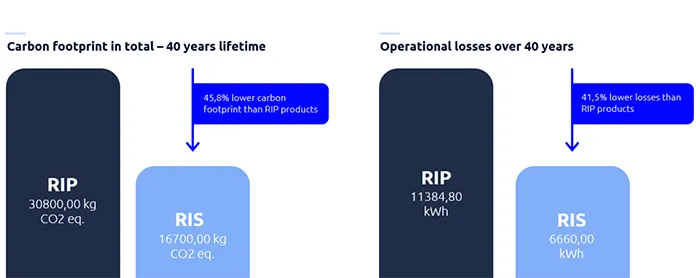
Fig. 7 compares the carbon footprint of RIP and RIS type condenser bushings under the following base line scenario: total life of 40 years and a realistic anticipated temperature based on an average load of 70% as in-service operating conditions. The results show that RIS condenser bushings have a 45.8% lower carbon footprint. In addition, operating losses are significantly less.

Ambient Performance of Silicone Outdoor Insulators
Another important consideration for condenser graded bushings is their outdoor performance since factors such as heavy wetting, pollution, and leakage current can reduce their insulation properties. In this regard, state-of-the art designs insulated with silicone rubber insulated have been introduced which also offer easier handling, lower weight, and better performance.
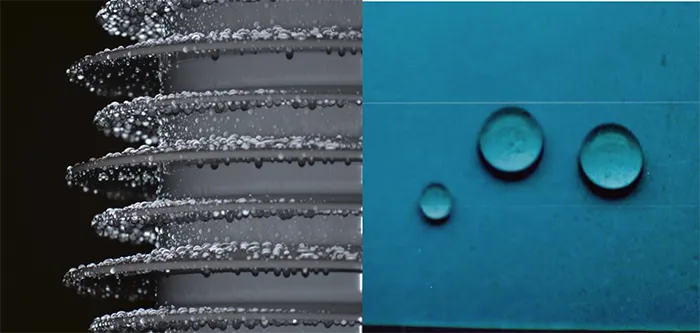
Due to inherent hydrophobicity, the surface of silicone rubber materials is water repellent. This prevents wetting of the entire surface. Accumulation of a conductive pollution layer is therefore kept to a minimum, mitigating risk of flashovers. Since the hydrophobic effect will also transfer over time to the surface pollution layer, high pressure washing of silicone rubber insulated bushings is not recommended. Should cleaning be deemed mandatory, most reputable suppliers offer guidance on proper cleaning procedures.
Conclusions
RIS type condenser bushings are now widely regarded as the best choice for application in high voltage AC and DC grids. Utilizing a synthetic non-woven as the carrier for epoxy resin is the most advanced technology.
Dry RIS condenser bushings offer better in service performance as well as other benefits when it comes to installation, commissioning and storage compared to OIP or RIP types, including:
• No paper and no insulation fluids such as mineral oil or ester fluids;
• Substantially reduced ageing due to no organic materials;
• Higher resistance to humidity due to a non-hygroscopic material;
• Lower dissipation factor compared to RIP bushings and no PD activity in electric field;
• Homogenous material characteristics – no voids in the condenser core;
• Substantially lower carbon footprint.
BIBLIOGRAPHY
[1] Publication IEC 60137 “Insulated Bushings for alternating voltages above
1 000 V”, 2017
[2] Publication IEEE Standard C57.19.00-2004 “General requirements and test procedures for power apparatus bushings”, 2004
[3] A. Del Rio, N. Lange, M. Mohamad, “Synthetic Dry Bushings for Application in HV Power Transformers & Reactors”, INMR World Congress, October 20th – 23rd 2019, Tuscon, Arizona, USA
[4] Publication IEC/IEEE 65700-19-03 “Standard for Bushings for DC application”, 2014
[5] J. M. Seifert, W. Hubl “Hydrophobicity effect of silicone housed composite insulators and its transfer to pollution layers – Design and environmental parameters influencing the hydrophobic surface behaviour”, Iraklion Symposium, April 26th – 27th 2001, Kreta, Greece