As described in this edited contribution to INMR by Austen Rau at Hubbell Power Systems, who also serves as Secretary, IEC Technical Committee TC 37, a collaborative effort has been underway between the surge arrester Standards Committees of the IEC and IEEE. The goal of this harmonization work has been to define a set of unified requirements to qualify surge arresters, such that one comprehensive set of tests would demonstrate that an arrester meets the minimum standards for use anywhere.
The advantages of this harmonization among standards include sharing knowledge and experience among diverse experts to update standards for improved product reliability as well as reduced test requirements. At the same time, this would allow surge arrester manufacturers to test products once and still meet multiple standards. Challenges, however, include navigating the standards development process within both the IEC and IEEE to build consensus.


Much of the harmonization work is being done to align the requirements of IEC 60099-4 and IEEE C62.11, the latest editions of which were published in 2014 and 2020 respectively. The scope of the current editions of these standards includes gapless metal-oxide surge arresters for a.c. systems with system voltage greater than 1 kV.
Publication of IEEE C62.11-2020 was a great step to harmonize the requirements with several clauses aligned, but some test clauses still require important changes for full alignment. Moreover, some other test clauses have minor differences still to be addressed. In addition, significant changes are being proposed for dead-front and separable arrester tests, and additional updates to the short-circuit and salt fog tests will require coordination and approval in both IEC and IEEE standards committees.
The scope of IEEE C62.11 also includes gapped metal-oxide surge arresters, while gapped arresters are covered by a separate IEC standard, 60099-6. The requirements for gapped arresters are largely aligned at this time, but upcoming changes under consideration for the next edition of IEEE C62.11 may require updating to IEC 60099-6 to maintain alignment.
A joint effort to produce a dual-logo standard IEC/IEEE 60099-11 was initiated in 2018 to produce a single harmonized standard for transmission line arresters, including both non-gapped (NGLA) and EGLA types. The first draft of this new standard is being finalized and will be circulated for comment in IEC and for initial ballot in IEEE this year, with the standard projected to be published in 2027.
After IEC 60099-11 is published, the EGLA-specific standard (IEC 60099-8) will be withdrawn, and a new edition of IEC 60099-4 will be published with all requirements for NGLA removed. The dual-logo process requires alignment of both IEC and IEEE standards development processes simultaneously as well as building consensus of experts in both standards committees. Ultimately, this will result in a harmonized standard.

Separable & Dead-Front Arresters
A joint IEC/IEEE task force led was formed to harmonize test clauses related to testing of separable and dead-front arresters. The task force has reached consensus on a proposal for the updated text, which will be subject to approval in both the IEC and IEEE standards development process. The changes apply to the insulation withstand, IEC power-frequency voltage-versus time, and failure mode/short-circuit tests.
In addition, two new terms – screened separable arrester and unscreened separable arrester – were introduced to distinguish different product types available in the global market. The key difference between them is that a screened separable arrester has a housing with a polymeric or metallic outer conductive ground shield whereas the unscreened separable arrester has no conductive shield.
For the insulation withstand test for separable arresters, products must withstand both a lightning impulse voltage test and a power-frequency voltage test. Screened separable arresters must withstand a lightning impulse with magnitude of the lightning impulse withstand voltage of the equipment to be protected or 1.15 times the lightning impulse protection level of the arrester, whichever is lower. For unscreened separable arresters, the 1.15 factor is increased to 1.3 to account for altitudes less than 1000 m.
Screened separable arresters must also withstand a power-frequency voltage with rms value of the power-frequency withstand voltage of the equipment to be protected or 0.46 times the lightning impulse protection level of the arrester, whichever is lower. For unscreened separable arresters, the 0.46 factor is replaced by 0.63 to account for altitudes less than 1000 m.
For the IEC power-frequency voltage-versus-time test, the preheat temperatures for screened separable arresters will be a minimum of 85°C, increased from 60°C, to align with the existing test parameters for the IEC operating duty and IEEE operating duty and temporary overvoltage tests to account for the higher temperatures expected for this application.
New short-circuit/failure mode classifications will be introduced for separable arrester products to distinguish product performance during the test for the safety of lineman who may be connecting or disconnecting separable arresters with a hot stick. The short-circuit/failure mode test will include four possible classifications with different evaluation criteria, as shown in Table 1.

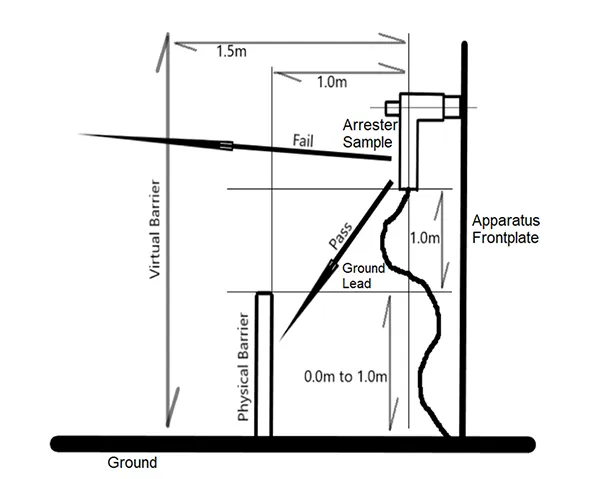
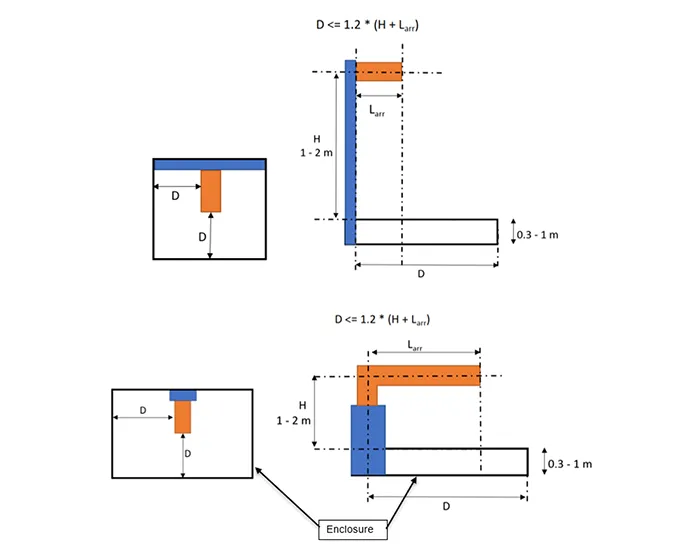
Evaluation Method 1 involves testing the product with a virtual barrier 1.5 m from the arrester with two possible classifications as shown in Fig. 1. For class 1A, no solids or arc plasma may directly cross the virtual barrier, while for class 1B, the ejection of solids or plasma must meet the ejection stated by the manufacturer.
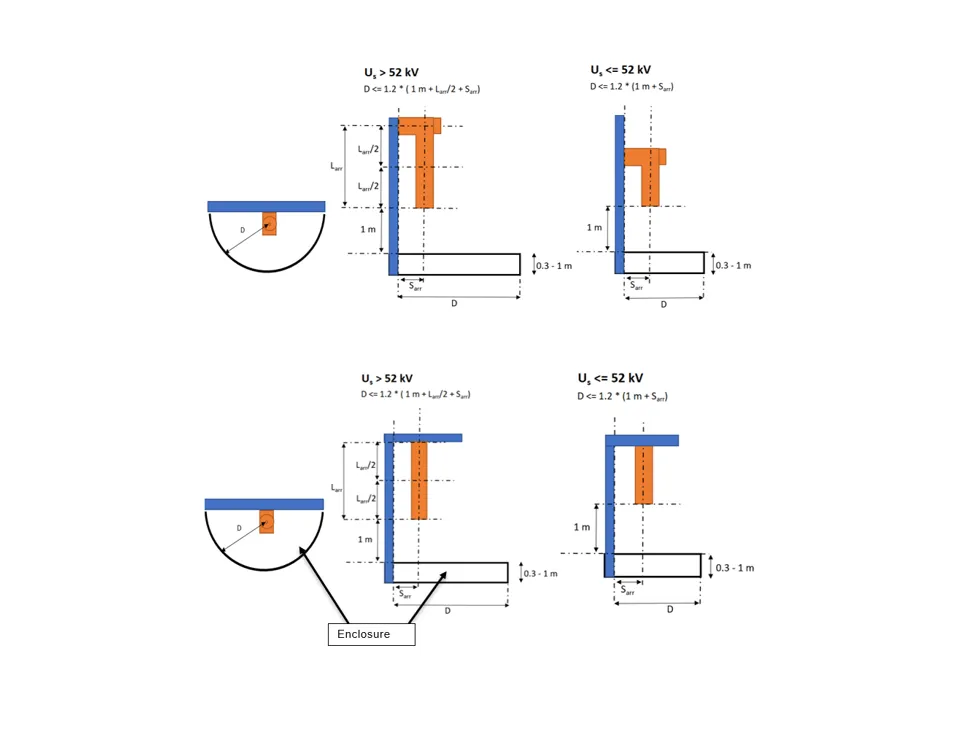
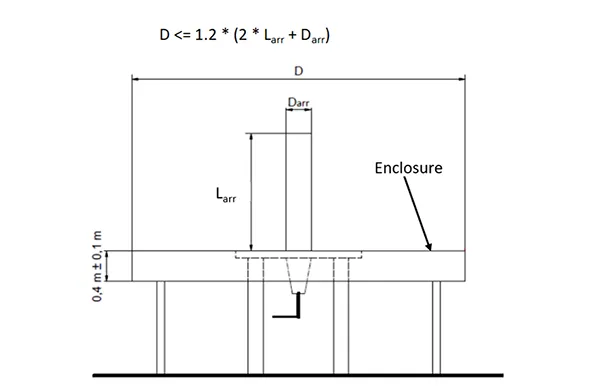
Evaluation Method 2 involves testing the product with an enclosure around the product with different possible mounting arrangements shown in Fig. 2 through 4. For class 2A, no solids with mass greater than 60 g may fall outside the enclosure, while for class 2B, the ejection of solids must meet the ejection as stated by the manufacturer.
If approved, these four classifications will be added in the next edition of IEC 60099-4 and IEEE C62.11, with the intention to eliminate classes 1B and 2B from the following edition for improved product safety.

Ultra-High Voltage (UHV) Surge Arresters
In IEC 60099-4 Ed. 3.0, requirements for UHV arresters for system voltages greater than 800 kV were introduced. But IEEE C62.11 does not include requirements for UHV surge arresters. A proposal to include additional text to align test requirements for UHV arresters with IEC 60099-4 Ed. 3.0 will be included in the ballot draft for the next edition of IEEE C62.11. These changes include:
1. Insulation withstand test – IEEE C62.11 currently includes specific requirements for switching impulse wet withstand voltage for arresters with maximum continuous operating voltage MCOV up to 460 kV, above which the requirements must be agreed upon between the manufacturer and the customer. The requirements from IEC 60099-4 Ed. 3.0 will be adopted for arresters with MCOV above 460 kV, including specific requirements on the switching impulse withstand test voltage for arresters intended for use with system voltages above 800 kV.
2. Switching impulse energy rating test (Wth) and Temporary overvoltage (TOV) test – To align with the IEC operating duty and power-frequency voltage-versus-time tests, the start temperature determination for UHV arresters will be performed according to text from Annex D of IEC 60099-4 Ed. 3.0.
Insulation Withstand Tests
Insulation withstand tests have been largely harmonized since publication of IEEE C62.11-2020, with some exceptions:
1. IEEE C62.11 includes a 10s wet power-frequency withstand voltage test across the insulating bracket for distribution arresters, while IEC 60099-4 does not include this requirement. Discussion is ongoing in the IEC working group on harmonization of this requirement, with the possibility of adopting this requirement in IEC 60099-4 with or without modification.
2. Both standards include an option to waive each insulation withstand test if the strike distance of the arrester exceeds a minimum value, but for the switching impulse voltage test, IEC includes a more conservative requirement for waiving the test based on knowledge and experience when the standard was developed prior to publication in 2014. Following publication of IEC 60099-4 Ed. 3.0, CIGRE Technical Brochure 696 introduced a less conservative limit for tests of the switching impulse withstand voltage, which was adopted in IEEE C62.11-2020. For harmonization, the IEC standards committee is considering adopting the same requirements that are now included in IEEE C62.11.

Accelerated Ageing Test of Metal-Oxide Disks
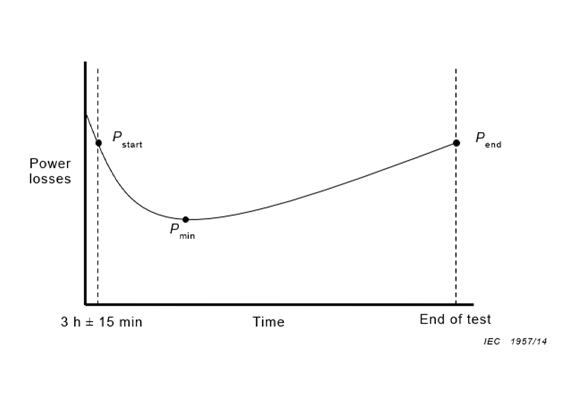
The test procedures are currently aligned for the accelerated ageing test of metal-oxide disks, but the evaluation criteria are different. In IEC 60099-4 Ed. 3.0, the power losses throughout the test period may not exceed 1.1 times the starting power losses, while in IEEE C62.11-2020, the only requirement is that the final power losses may not exceed the initial power losses. IEC 60099-4 also includes an additional requirement that after the power losses reach the minimum value throughout the entire test period, the power losses may not increase more than 30% above the minimum power losses, so there is a limit on the upward trend of the power losses after reaching the minimum during the test period. Additional discussion is needed to harmonize the evaluation criteria for this test. It should be noted that the dual-logo IEC/IEEE 60099-11 standard is proposing to combine the evaluation criteria of both standards.
Salt Fog Test
The salt fog test is mostly aligned in the current edition of the standards. However, IEC 60099-4 is planning to adopt changes to the test procedure to align with changes to tracking and erosion test in the insulator test standard IEC 62217 Ed. 3.0. Any changes made in IEC 60099-4 would also need to be adopted in IEEE C62.11 to maintain harmonization. The proposed changes include:
• Clarification that a turbo sprayer (room humidifier) shall be used as a water atomizer that is specified to form water droplets of 5 µm to 10 µm, to address concerns from the existing text that the size of the water droplets must be measured;
• Addition of a fog calibration procedure to verify rate of precipitation in the test chamber, because the precipitation rate is more representative of the fog concentration in the test chamber than the flow rate to the sprayer/humidifier;
• Specification of the initial salt content of the water based on the diameter of the trunk of the arrester and the strike distance and leakage distance of the arrester to prevent frequent flashovers during the early part of this test;
• Allowing weekly planned interruptions not exceeding 1h due to the length of the test to accommodate laboratory maintenance;
• Allowing fog intensity reductions or interruptions not exceeding a total of 60h during the test, but if any fog disruptions longer than 1h occur, the interruption time is not counted towards the test duration and an additional testing time of three times the interruption period shall be added;
• Providing a method to determine if tracking occurs during the test by measuring the resistance of the suspect tracking path with a megohmmeter, with tracking occurring if the resistance is less than 2 MΩ.
In addition, the salt fog test requires testing the longest electrical unit of a surge arrester design, but as manufacturers produce longer arrester units with higher maximum continuous operating voltage, the required size of the test chamber and test voltage in some cases exceed capabilities of available laboratories across the world.
However, because evaluating the effect of radial field stress is one goal of the salt fog test, reducing the sample size to a sample of shorter length and lower maximum continuous operating voltage may not accurately capture possible failure modes associated with radial field stress. As such, the IEC standards committee is working to develop a separate radial field stress test, which is still in progress.

UV Light Test
IEEE C62.11 currently allows this test to be performed with carbon-arc, xenon-arc, or fluorescent lamps. IEC 60099-4 currently allows either xenon-arc or fluorescent lamps but is proposing to allow only xenon-arc lamps in the next edition of the standard which more closely matches the full solar spectrum, which is based on proposal in CIGRE Technical Brochure 488 and changes in insulator standard IEC 62217 Ed. 3.0. Although IEEE C62.11 allows more lamp options for this test than IEC 60099-4, the test can be performed in a way that would satisfy both standards.
Accelerated Ageing Test of Polymer-Housed Distribution Arresters with Exposure to Electrical Stress
This test is included in IEEE C62.11 but not in IEC 60099-4 and is intended to evaluate the performance of the polymer housing of a distribution arrester from repeated dry band arcing due to contamination and intermittent wetting of the housing surface while energized. The test also evaluates the ability of the insulating bracket to withstand system voltage over a short period of time (20h) after an arrester short-circuits. Harmonization would require that this test be adopted in IEC 60099-4.
Repetitive Charge Transfer Rating (Qrs) Test
The Qrs test is mostly harmonized in the current edition of the standards, with a few exceptions that will be addressed in upcoming editions.
• Claimable Qrs ratings are currently different with some overlap. The proposed new harmonized ratings are:
o 0.1 – 2.0 C in 0.1 C steps
o 2.0 – 4.0 C in 0.2 C steps
o 4.0 – 8.0 C in 0.4 C steps
o For higher values, the requirements shall be agreed between manufacturer and user.
• The IEEE standard requires testing MOV disks with the highest residual voltage for a design, but if those blocks are not available, then the required charge content of each impulse increased by a compensation factor of f = maximum allowed residual voltage/measured residual voltage. The IEC standard requires this compensation factor only if the measured residual voltage of the sample is more the 3% below the maximum allowed residual voltage.
• IEEE allows testing MOV disks for distribution applications with either 8/20 µs lightning impulses or 2 ms rectangular waves, while IEC allows only 8/20 µs lightning impulses. The option for rectangular wave will be eliminated in IEEE for distribution MOV disks.
Test Bending Moment/Maximum Design Cantilever Load (MDCL) & Moisture Ingress Test for Polymer-Housed Arresters
Mechanical tests for polymer-housed arresters are mostly harmonized with the following exceptions, which would require work in one or both standards committees for full harmonization.
• The MDCL test in IEEE C62.11 requires testing only one sample for each combination of housing and end fitting design, while the bending moment test in IEC 60099-4 requires testing three samples. The IEC bending moment test procedure requires a mechanical/thermal preconditioning test on one sample loaded at the specified long-term load (SLL), similar with IEEE’s MDCL test procedure. The other two bending moment test samples are subjected to a bending moment test to specified short-term load (SSL), which is not included in the IEEE MDCL test procedure;
• In addition to the test procedure above, the IEC bending moment test requires a cyclic loading fatigue test comprising 1000 cycles to SLL on all three samples for arresters intended for system voltages greater than 52 kV. A comparable requirement is not included in IEEE C62.11;
• For the water immersion portion of the test, both standards specify that the sample be immersed in boiling salt water for 42h to confirm the seal of the arrester remained intact after mechanical loading. Because arresters do not generally encounter boiling water in the field, and some arrester designs may include materials not intended for exposure to boiling water, the water immersion test may alternatively be performed with the arrester immersed in salt water at a temperature of 80°C. However, the durations of the 80°C water immersion test differ between the standards. IEEE C62.11 requires a duration of 168h at the lower temperature, while IEC 60099-4 specifies 52h at the lower temperature with the option to extend the time up to 168h after agreement between the manufacturer and user. Full alignment will require agreement between the standards working groups on the appropriate duration of the lower temperature water immersion test;
• At the end of the IEC bending moment test procedure, a reference voltage measurement, two evaluation impulses, and a final reference voltage measurement are included to confirm no damage to the MOV disks during the test, but these final electrical measurements are not included in the IEEE MDCL test procedure.
Distribution Arrester Seal Integrity Test
This test applies to all distribution arresters as a means of confirming that high-temperature stress over long periods do not change the basic function of the arrester as well as verifying that daily and seasonal temperature variations do not result in seal pumping which would lead to moisture ingress and is only required in IEEE C62.11. IEC 60099-4 does not include a comparable test for arresters. But tests of the arrester disconnector include a seal pumping test that only applies to disconnectors, not arresters. Harmonization work is needed in one or both standards committees to align these requirements.

Short-Circuit Test
The current editions of standards have a harmonized short-circuit test except for the diameter of the test enclosure, which for IEEE is the diameter of the test sample plus twice the sample height. For IEC, the enclosure diameter is 20% larger than the diameter required in IEEE to allow for the possibility of a passing result if the sample falls over during the test. Although the short-circuit test is almost entirely harmonized, a joint task force with members from both IEC and IEEE working groups is revising this test clause. This effort is still underway, but one change planned is to update the definitions for Design A, which would include any design that has a gas channel intentionally included in the design, and Design B, which would have no intentional gas channel.
Heat Dissipation Behavior/Thermal Equivalency Test
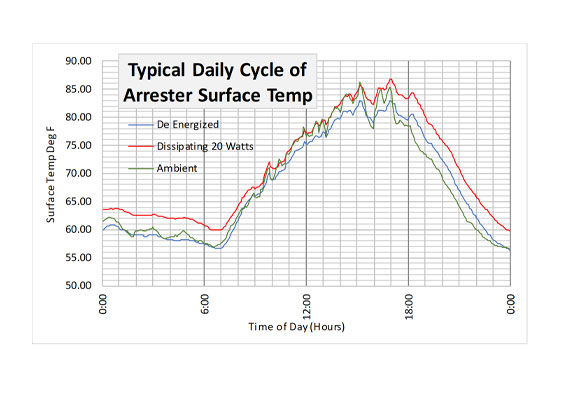
Both standards use the same procedure for measuring the temperature for cooling curves of prorated sections and complete arresters, but the standards use different methods to determine the preheat temperature used in the thermal recovery tests. IEC 60099-4 establishes cooling curves by calculating a relative overtemperature which is a normalized quantity that accounts for the average ambient temperature during the test, while the cooling curves in IEEE C62.11 are simply the measured temperature. The IEEE Working Group is considering adopting the IEC method, since heat flow depends on temperature gradient.
Operating Duty Test
The operating duty test and switching surge energy rating test are mostly aligned with some differences that may require performing separate tests. Discussion is ongoing to align the requirements of this test.
• Magnitude of the high current conditioning impulses for station class arresters is different in the current edition of the standards. IEEE requires testing with 65 kA 4/10 µs conditioning impulses in the switching surge energy rating test, while IEC requires testing with 100 kA 4/10 µs conditioning impulses for all station class arresters in the operating duty test;
• The claimable thermal energy ratings Wth are specified per unit of MCOV in IEEE and per unit of rated voltage Ur in IEC. Because of this, there is misalignment in the claimable Wth ratings. Since duty cycle voltage rating was eliminated in IEEE C62.11-2020, full harmonization would require IEC to convert Wth ratings to per unit of Uc;
• During the thermal recovery portion of the test, IEC requires application of Uc to the test samples for 30 min, while IEEE requires application of VREC which is MCOV compensated by a factor to account for the maximum allowable power losses of the MOV disks for each sample at room temperature. Further work is needed to harmonize this requirement.
Temporary Overvoltage (TOV) Test/Power-Frequency Voltage-vs-Time Test
The TOV test is mostly harmonized except for differences in required duration ranges within which a sample must be tested. Although there is misalignment in the time ranges, test durations can be selected such that the requirements of both standards could be satisfied. Additional work in one or both standards committees would be needed for full harmonization.
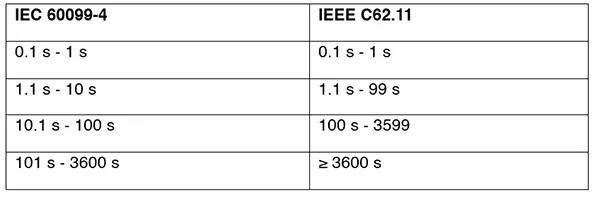
This recovery voltage misalignment for the operating duty test also applies to the TOV test.
Conclusions
Efforts to harmonize IEC and IEEE arrester test standards have been ongoing. This work has produced standards whereby many tests can be performed in a way to test a product once to qualify it to multiple standards.
However, some differences in test requirements still exist, and upcoming improvements to test procedures are planned that will require coordination in both IEC and IEEE standards to maintain harmonization. Ultimately, collaboration between experts in IEC and IEEE Working Groups will improve standards and reliability of components such as surge arresters through shared knowledge and experience.


References
[1] IEC 60099-4 Ed. 3.0, Surge arresters – Part 4: Metal-oxide surge arresters without gaps for a.c. systems, 2014.
[2] IEEE C62.11, IEEE Standard for Metal-Oxide Surge Arresters for AC Power Circuits (>1 kV), 2020.
[3] IEC 60099-6 Ed. 2.0, Surge arresters – Part 6: Surge arresters containing both series and parallel gapped structures – System voltage of 52 kV and less, 2019.
[4] IEC/IEEE 60099-11 Ed. 1.0, Surge arresters – Part 11: Metal-oxide surge arresters to protect power line insulation, unpublished/in progress.
[5] IEC 60099-8 Ed. 2.0, Surge arresters – Part 8: Metal-oxide surge arresters with external series gap (EGLA) for overhead transmission and distribution lines of a.c. systems above 1 kV, 2017.
[6] CIGRE Technical Brochure 696, MO surge arresters – Metal oxide resistor and surge arresters for emerging system conditions, 2017.
[7] CIGRE Technical Brochure 488, Resistance to Weathering and UV Radiation of Polymeric Materials for Outdoor Insulation, 2012.