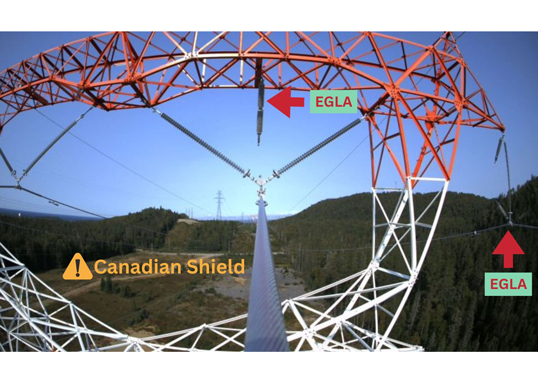
Externally gapped line arresters (EGLAs) are advanced protective devices used in high-voltage transmission systems to safeguard equipment and improve resilience to lightning-induced overvoltages. Unlike traditional surge arresters without a series air gap used for both substation and line applications (NGLAs), EGLAs feature an intentional air gap between the surge varistor unit (SVU) and the conductor. This gap conducts (i.e. turns on) and permits controlled current flow to earth during only targeted overvoltage events without system disturbance.
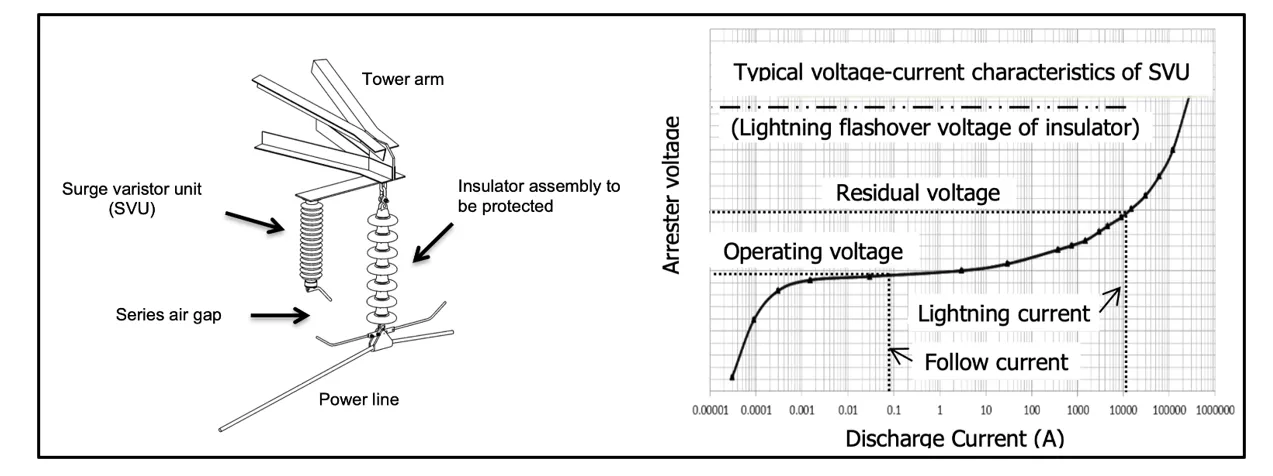
Fig. 1, taken from CIGRE TB 855, outlines the generalized concept of an EGLA incorporating the series air gap protection for the phase insulation of an overhead transmission line, and the typical operating characteristics for the SVU in series with the air gap.
EGLAs, including their series air gaps, are dimensioned to avoid inadvertent triggering from defined overvoltages associated with typical insulation coordination design considerations for transmission lines. This design for the EGLA series air gap shall generally ride-through and not operate for the following overvoltage events:
1. Temporary but relatively long duration power frequency voltage excursions which are a function of the power system earthing and system topology (e.g. effectively earthed neutral and associated system earth fault factors);
2. Slow fronted switching surge overvoltage events up to a statistically defined switching surge overvoltage factor (e.g. S2) forming an integral part of the defined transmission line electrical design parameters for the line design.
Exclusion of long duration current conduction events allows the charge transfer capacity (Qrs) of the metal oxide varistor (MOV) blocks to be optimized and thus sized smaller specific to EGLA applications. If strictly comparing the expected lightning discharge current through NGLAs and EGLAs, major difference in Qrs requirements would not be observed, aside from slight variations due to different residual voltages.
Nonetheless, especially for EHV/UHV lines, EGLA applications are not required to operate under switching surge overvoltages. Therefore, there is no need to dimension MOV blocks for typical switching events, thereby allowing for optimized MOV design compared to NGLA installations under the same system parameters. There is also a statistical appreciation of the probability of SVU failure from exceeding the charge transfer rating of the selected MOV block size with this specification approach.
The series air gap is sized statistically to reliably spark over for fast fronted waves associated with localized lightning strikes only. This ensures the EGLA provides adequate protective margin below the statistical flashover characteristics for the insulation string and/or the structure air gap geometry defined by their respective statistical critical flashover voltages (V50).
Once spark-over occurs for the series air gap, the arrester conducts, limits the overvoltage and safely diverts the surge energy to ground. In the context of the transmission line circuit, this ensures the protected phase(s) or all phases (complete circuit) rides through the overvoltage event that occurs only in the vicinity of the protected structure with EGLA installation arrangement. After the surge has passed, the gap remains ionized, allowing the power-frequency voltage across it to establish a small follow current—limited by the SVU—typically in the range of a few amperes. This current is interrupted in less than half a cycle, after which the system returns to its normal, non-conductive state.
Their reported simplicity, low maintenance, high reliability, and optimized energy handling capability have made EGLAs a preferred solution in modern power systems in numerous countries allowing accrual of significant operational experience, especially in countries or regions with frequent lightning activity.
Plan to attend the upcoming 2025 INMR WORLD CONGRESS in Panama. Glenn Stapeton, Principal Engineer Lines & Cables at Powerlink Queensland in Australia will outline the challenges faced to successfully consider a step change adoption of EGLAs where such a solution has never been tried before. He will also present a case study for a proposed greenfield application of EGLAs to a long 330 kV AC double circuit radial transmission line. This will provide key lessons to help guide utilities who may consider adopting EGLAs but who still have limited to no experience with this technology.